

A senior school production is an ambitious project. “MacBharat” was complex on top, as it became a contemplative study of two tales.
A Scottish thane lets prophecy consume him until a stolen crown burns the brow that wears it. An ancient dynasty fractures because an entitled prince cannot bear to share the earth. Both stories circle the same devastating question: What do we lose of ourselves in the reaching?
At first glance, eleventh-century Scotland and epic Hastinapur belong to different universes—one steeped in damp mist, blood-feuds, and blank verse; the other in sweeping Sanskrit shlokas, dynastic duty, and cosmic philosophy. Yet when our senior learners mounted MacBharat, they revealed that these two worlds are separated only by eras, never by human nature.
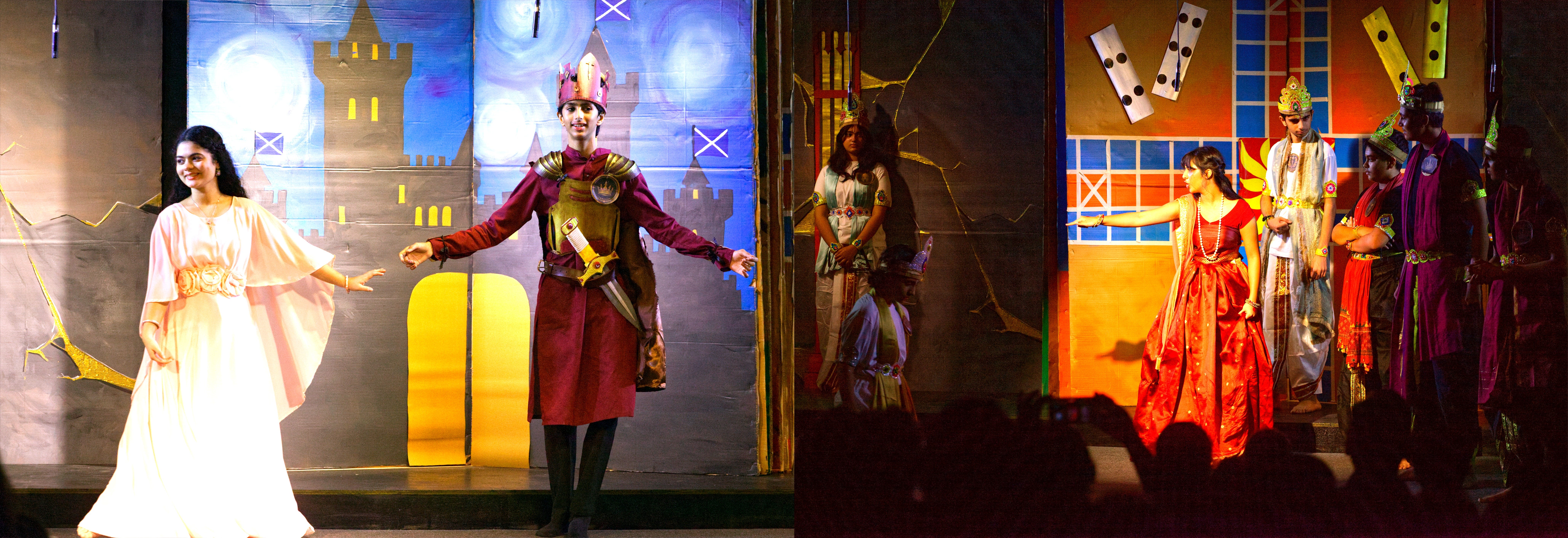
By staging Shakespeare’s Macbeth alongside Vyasa’s Mahabharata, the production moved past routine school theatre into a real inquiry into ethics, agency, and the cost of power.
The Spark: Teachers’ Lounge
The production did not begin with a curriculum committee. It began with a simple, unprompted question from two children to their grandmother:
“Was Duryodhana like Macbeth? And was there a Banquo in the Mahabharata?”
That inquiry revealed something vital: our learners live naturally at the intersection of two cultures. They analyze Shakespeare for board examinations by day, and absorb the moral dilemmas of the Mahabharata through family stories by night. Rather than leaving those worlds compartmentalized, Director Saurabh Shukla with Script Writer and Lead Director Shuchi Mishra chose to weave them into a shared dramatic space.
The framing was deliberately intimate: not an alien heath, but the timeless space of a grandmother unraveling truth for a curious child, underpinned by Sanjay’s all-seeing narrative gaze (Sanjay Uvaacha).
"You think the battle is out there. It's not. The battle is here—between the man you want to be, and the man the moment demands."
To make original Elizabethan cadence and epic verse accessible within an intense 45-day rehearsal window, the directing team implemented the 4E Framework:
Experiential: Reliving legendary archetypes through constant, active vocal and physical exploration rather than passive table-reads.
Embodied: Translating abstract philosophy into physical weight. To grasp meter, learners walked the rhythmic cadence of iambic verse; to understand Dharma, the learner playing Arjuna physically dropped his Gandiva bow repeatedly, answering the question: When have you felt your own bow slip?
Ethical without Moralizing: Humanizing the tragic figures. Duryodhana and Macbeth were not played as pantomime villains, but as accomplished warriors who recognized their moral compromises. Macbeth knew he should protect his sleeping guest—a direct reflection of Atithi Devo Bhava—making his violation of that sacred trust hit with tragic weight.
Evidential: Equipping learners with classic rhetorical tools—monologues, asides, ethos, and pathos—to let them discover meaning through language.
Day 28: The Rehearsal Breakthrough
Every production has a day when the script ceases to be memorized text and becomes lived truth. For MacBharat, that shift came on Day 28 during the confrontation between Arjuna and Krishna.
Until that afternoon, the cast had subtly defaulted to binary characterizations: Macbeth was the “bad” guy, Arjuna was the “good” guy. Then came the line:
“You think the battle is out there. It’s not. The battle is here. Between the man you want to be and the man the moment demands.”
A quiet realization rippled through the room. The learner playing Macbeth paused and said:
“I don’t want to kill Duncan. But if I don’t, I will be nothing.”
The learner playing Arjuna looked back and responded:
“I don’t want to kill my cousins. But if I don’t, Dharma will be nothing.”
The room went still. The learners had cracked the thematic core on their own: both warriors suffer from the same human vulnerability—ambition justified as destiny. The difference lies in moral agency. Macbeth surrenders his conscience to satisfy his ego. Arjuna surrenders his personal desires to uphold Dharma.
Fractured Walls and the Art of Kintsugi
Staging two epic worlds back-to-back without disorienting the audience was the spatial puzzle handed to Set and Costume Designer Priyanka Oberoi.
Rather than building literal, cumbersome sets for castles and battlefields, the design leaned on evocative symbolism:
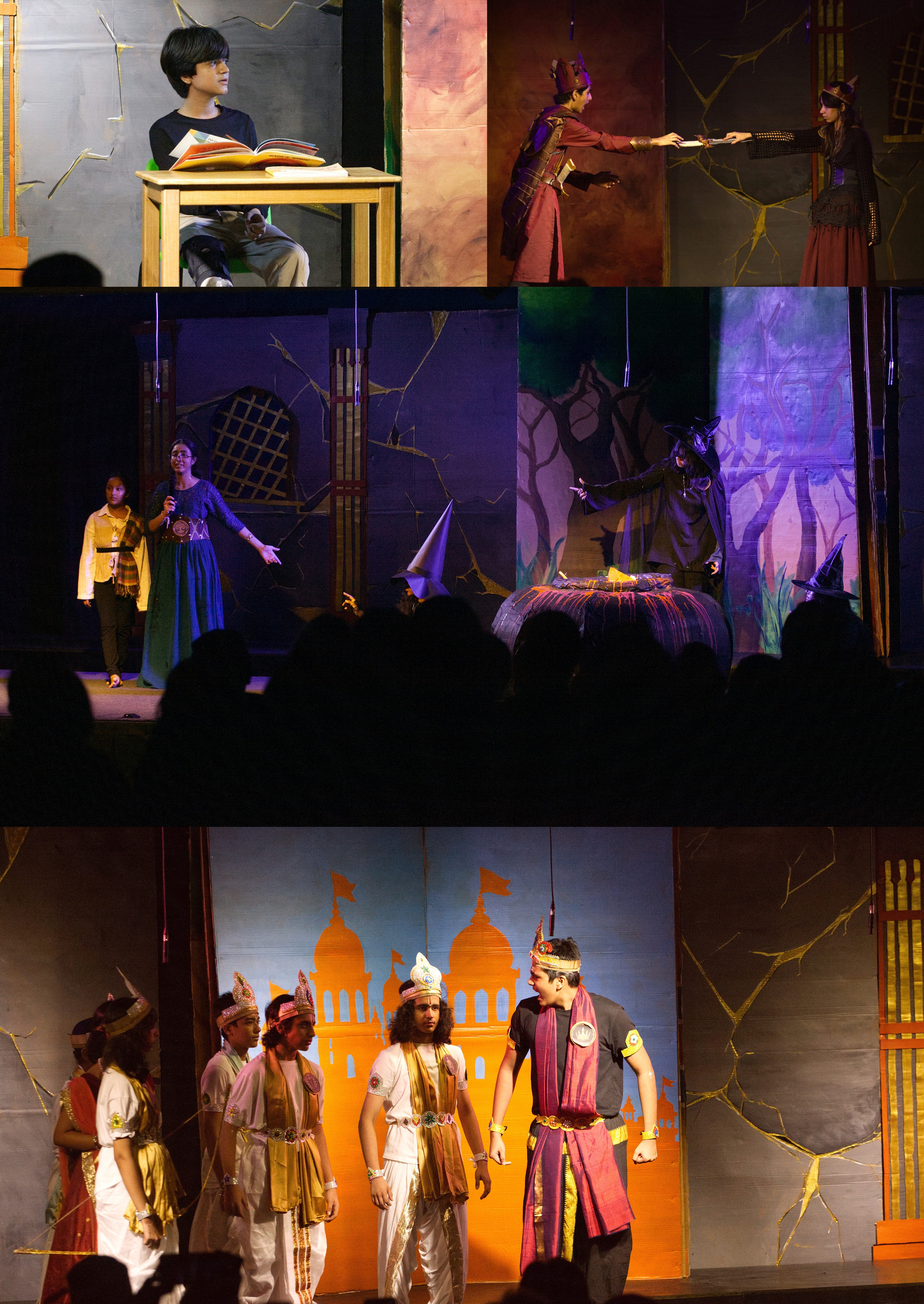
The Kintsugi Palace Walls: Flanking the stage were fractured walls inspired by Kintsugi, the Japanese tradition of mending broken ceramic vessels with gold. The visible gold veins honored fractures rather than hiding them—symbolizing dynasties cracked by ambition, betrayal, and time, yet bearing the scars of survival.
The Giant Book & The Book Keeper: Center stage held an oversized open book whose massive pages were physically turned to transport the audience from Scottish stone chambers to the royal courts of Hastinapur. During tech runs, this mechanical necessity transformed into a key theatrical motif: a learner crew member stepped out as The Book Keeper, stepping in the character to turn the leaves of history in full view of the audience.
The Architecture of a Costume: Crowns, Shadows, and Alter Egos
The visual design embraced cultural contrast while anchoring characters in shared archetypal roles:
Texture and Form: Scotland was built with rugged, angular cardboard armor and defensive shields; Hastinapur gleamed with layered decorative drapes, gold accents, and fluid movement.
The Tale of Two Crowns: King Duncan ruled under an honorable, celebratory golden crown. When Macbeth seized power, he wore an identically shaped crown cast in blood-red. The identical silhouette linked their sovereign claims; the jarring color shift declared that Macbeth’s authority was bought with blood.
The Morality of Hue: The Kauravas and Pandavas were presented with equal princely majesty. To clarify their philosophical divide without diminishing their royal status, the Pandavas wore pure white with silver crowns (symbolizing restraint and clarity), while the Kauravas wore imposing black adorned with gold crowns (symbolizing pride and unyielding desire).
The Fractured Psyche of Lady Macbeth: Perhaps the most haunting staging device was splitting Lady Macbeth into three physical presences. As her descent began, she was shadowed by two alter egos who circled and mirrored her movements:
Lady Macbeth: Dressed initially in soft rose-pink, showing composure and aristocratic status.
Alter Ego 1 (Ambition): Clad in vivid red and black, whispering the seduction of power.
Alter Ego 2 (Guilt): Draped in deep maroons and heavy blacks, pulling her downward into the psychological ruin of the sleepwalking scene.
By externalizing her subconscious, the staging turned the famous soliloquies into dynamic, three-part internal struggles.
Action Without Attachment
The performance closed not with the sound of clashing steel, but with an invitation to reflect on action.
Through Krishna’s discourse to Arjuna at Kurukshetra, the ensemble presented a resolution to the tragedy of Macbeth: an ambition grounded in duty rather than self-aggrandizement. Nishkama Karma—striving without clinging to the fruit of the action. It offered an alternative to Macbeth’s despairing realization that life is merely a “tale told by an idiot, full of sound and fury, signifying nothing.”
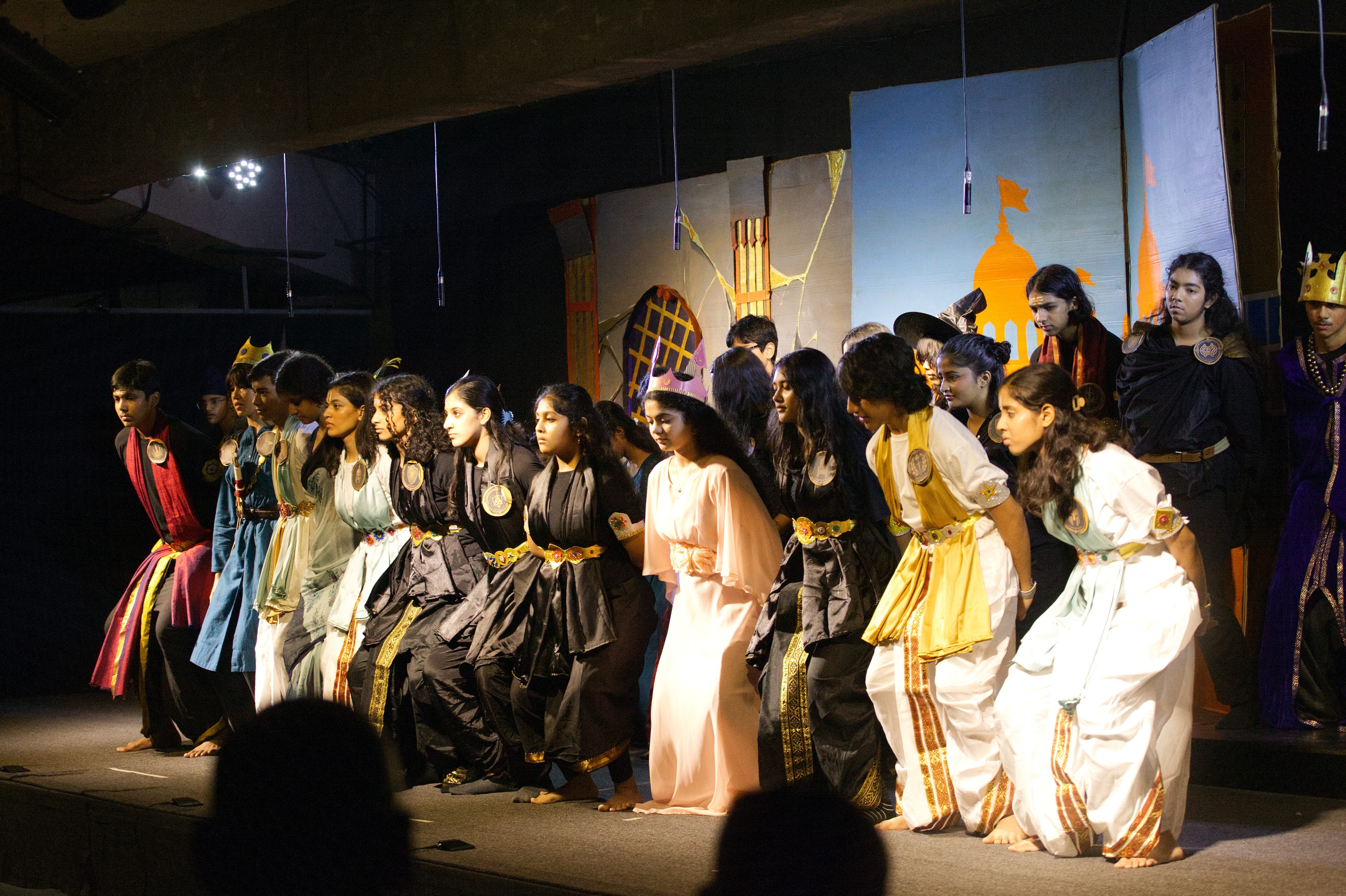
When the cast took their final bows, each member of the audience held a small virtue sticker handed to them upon entry. The gesture tied the final bow on the morning: these ancient kings, queens, and warriors are not distant relics. Their virtues, flaws, and temptations live within us every day.
In Their Own Words: The Actors’ Reflections
The most profound insights of the production didn’t just happen under the stage lights; they happened internally. Stepping into the heavy, flawed shoes of ancient monarchs and warriors forced the cast to grapple with the very real consequences of unchecked desire, loyalty, and moral silence. Here is how the learners processed the weight of their roles:
“What drew me to playing Macbeth was how ambitious he was, but before vaulting ambition took over him—how clear of a conscience he had.”
— Saideep (Macbeth)
“What drew me to her was her ambitious personality. She has so much power in her that she can convince Macbeth to commit the murder and take up such a grave task.”
— Noor (Lady Macbeth)
“Banquo and Macbeth both heard the same prophecy. But Banquo is very skeptical... I think that serves as a great lesson to think critically before you hear anything from anyone.”
— Saanvi (Banquo)
“What resonated with me was his sense of duty and pride. Even though his father was dead and he could flee the kingdom... he still chose to come back and help save Scotland.”
— Navya (Malcolm)
“Ambition is good... but seeing how Macbeth and Lady Macbeth fall so deep into it that they kill their own friends... if you just strive for one single thing, then how can you do other things?”
— Anushka (The Witches)
“I tried to make myself into a character that knows he is right, even if he is not.”
— Kartikya (Duryodhana)
“She’s basically asking the whole court: if you’re in such high positions, how can you still be of such low mentality? How can none of you speak up? That’s what stayed with me.”
— Mishika (Draupadi)
“I was narrating the story... I had to bring to life a grandmother who is supposed to be modern. Those two factors are opposing, so I didn’t know how to bring that to life at first, but it worked out.”
— Mukti (The Grandmother / Narrator)
The ultimate question left behind was not how well the learners remembered their lines, but a quieter inquiry for everyone walking out of the auditorium:
When ambition knocks at your door, which virtue will define your answer?

Click the image above to experience the complete stage production.