
We Become What We Read
The stories stay with us - the book reading festival focused on Indian authors, presented us with children's literature that is rooted in our culture

In a world flooded with books, being selective about what our children read is one of the most important responsibilities we carry as educators and parents.
There is a common myth that “any reading is good reading,” especially with the heavily marketed international bestsellers that dominate children’s sections. While these books can be entertaining, they often don’t reflect our children’s realities, culture, or context. True reading is not just about consumption — it is about nourishment. The stories we choose shape how children see themselves and the world around them.
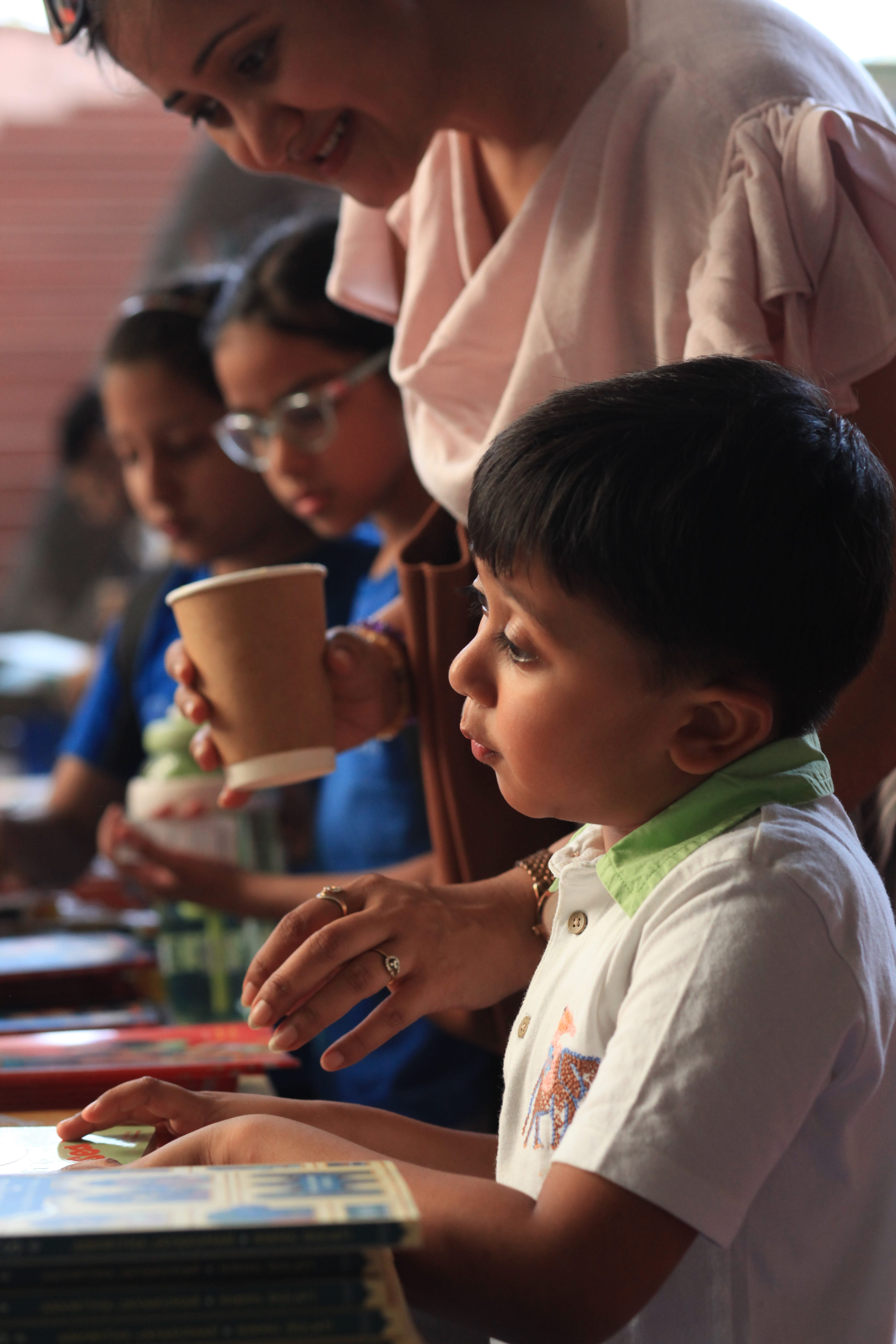
Culture travels through stories. Children need to read stories that represent them in order to build their own identities and then learn to empathise with nature, heritage and diversity around them. What they read makes them to a significant extent. The book reviews and reflections that they write and pin on our library pin boards tell us that too.
This can only happen if we introduce them to Indian authors. Because of years of colonization and huge marketing budgets, the bookshops are filled with best sellers from overseas – especially the UK and the US. Today, Indian children’s literature is flourishing. As a school, to take a step forward to encourage and popularize Indian authors, we decided to invite them to school.
Schoolaroo — Prakriti School’s first in-campus literature festival in collaboration with Bookaroo held on 25th April 2026 — was born from this very intention. With 13 inspiring Indian authors and storytellers, the day truly turned our campus into a “living, breathing world of books”.
When we spoke with the authors after their sessions, their faces were glowing with joy. Here’s what they shared with us:
Chandrima Chatterjee told us how two moments stayed with her: “One child responded that they didn’t want to preserve memories… Another child beautifully sketched her sisters and best friends but left no space for herself.”

(Click/tap on the image to see her publications, swipe left/right )
She smiled and said our students were “a lively bunch” who kept asking curious questions about how books are made.
Samina Mishra shared warmly, “I wanted them to find a connection with the characters… and I think it happened when they shared doing or feeling similarly to the characters in the story.”

(Click/tap on the image to see her publications, swipe left/right )
She loved sitting in a close circle with the little ones and watching them draw enthusiastically afterwards.
Ashwitha Jayakumar recounted with delight how a student and his mother came up to her and said they “had never heard anyone talk about the Mughals in the way I did — humanising them and making them feel real.”

(Click/tap on the image to see her publications, swipe left/right )
They told her they would “never forget the session.” She called our children “enthusiastic, curious and the perfect audience.”
Mamta Nainy described one of the most touching moments: When she showed an illustration of loneliness, “even before I explained anything, most of the children instinctively responded to the feeling in the image.”

(Click/tap on the image to see her publications, swipe left/right )
She was visibly moved by “the abandon with which they approached their self-portraits” once the pressure of being perfect was removed.
Meghaa Gupta spoke about a student’s sharp observation that impressed her: “A student said that industrialisation needed a customer base and that cotton industries served such a base.”

(Click/tap on the image to see her publications, swipe left/right )
She felt the children were genuinely reflecting on how history shapes our everyday lives.
Vasudha Ahuja was still buzzing with energy when we met her.

(Click/tap on the image to see her publications, swipe left/right )
“The response was overwhelming… the sing-alongs were wonderful and the children came up to me afterwards wanting to read more books.”
Peggy Sood shared how engaged both parents and children were.

(Click/tap on the image to see her publications, swipe left/right )
Several parents told her they were motivated to start regular reading time at home and wanted to begin that very day.
These conversations revealed how deeply our students connected with the sessions. In the safe and familiar setting of their own school, they asked bold questions, shared personal experiences, and created with joy and courage.
Our school library and book corners are thoughtfully curated with outstanding books — many by Indian authors — that are readily available. We strongly encourage every student to get hold of a copy, borrow them regularly, read together in class, and bring the stories into your conversations at home.
We also invite you to build your own personal library. Owning books is special — you can underline lines that move you, return to them anytime, and one day pass them on.
To every child who participated with an open heart, to the parents who joined us, to all 13 authors who inspired us, and to the Bookaroo team — thank you. You helped create something truly special.
Schoolaroo has ended, but the journey of mindful reading has only just begun.
Keep reading. Keep questioning. Keep discovering stories that matter.
Happy Reading!