
Two White Coats, Two Worlds
Through the firsthand accounts of two anonymous doctors, this piece examines the dual reality of healthcare in modern India by Namah Saxena, Grade 11

Introduction
Becoming a doctor is often seen as the highest form of service to humanity. The power to heal and preserve life is a rare privilege, and many people, including myself, work relentlessly and make significant sacrifices to earn the right to wear the white coat. In India alone, over 2.3 million students appear for NEET each year, competing for roughly 1.1 lakh MBBS seats, highlighting how difficult it is to even enter the profession.
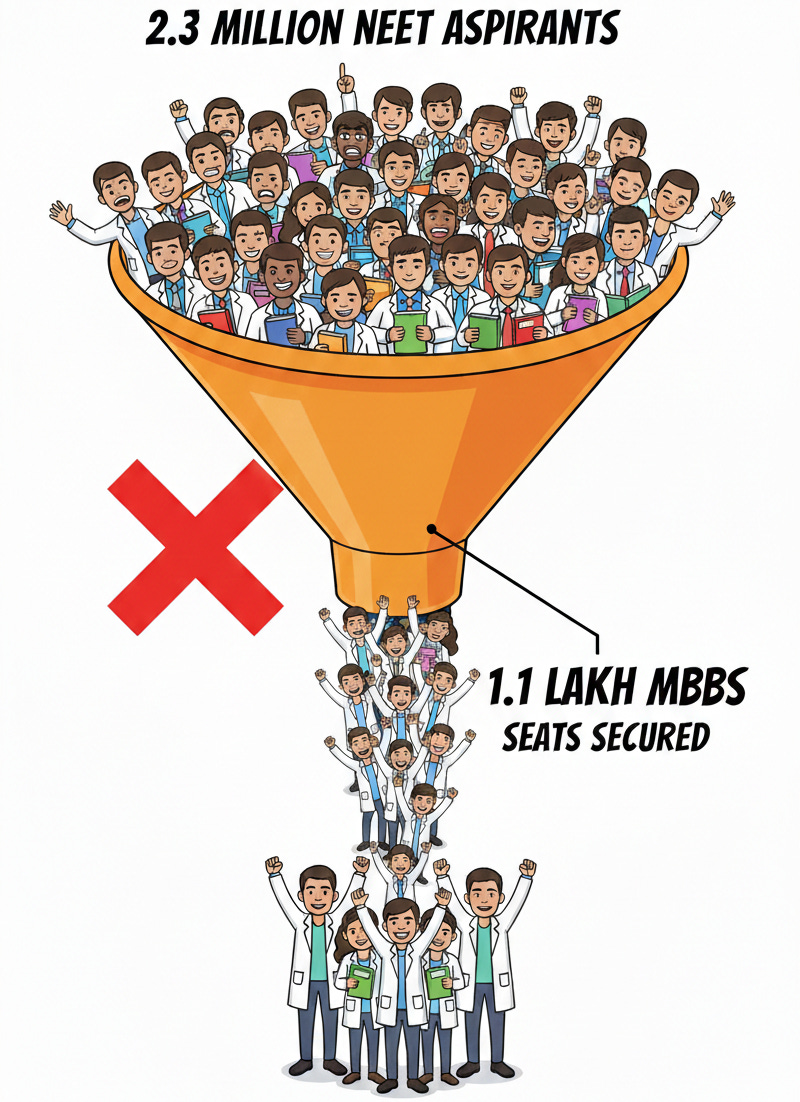
However, when that moment finally arrives, not all doctors step into the same reality. While some practise in well-equipped urban hospitals surrounded by comfort and recognition, others serve in rural areas where resources are scarce and appreciation is limited. According to the Ministry of Health and Family Welfare, nearly 65% of India’s population lives in rural areas, yet only about 23% of doctors serve there. As a result, many graduates are surprised to discover that a doctor’s life can differ greatly depending on where they choose, or are forced, to practise.
A Day in the Life of an Urban Doctor
To understand the life of an urban doctor I interviewed, here are my findings (the source does not wish to be named therefore for the sake of this article we shall name him Prashant).
Prashant starts his day off in his 3BHK in NOIDA, a city that forms part of the National Capital Region, home to some of the highest doctor-to-patient ratios in the country. He prepares some coffee for himself, picks up his car keys and goes off to work. Being a junior doctor, he could only afford a second-hand 2020 Maruti Suzuki Alto, a common choice considering that resident doctors in private urban hospitals earn between ₹50,000–₹80,000 per month on average.
Upon reaching the hospital the guard, as usual, greets him with a curt nod. Entering the elevator he thumbs the button for the first floor to enter his chamber. Cracking his knuckles he gets ready for the day and summons his first patient of the day. Then another, then another, then one more. On average, an urban outpatient doctor sees 25–40 patients per day, a manageable number aided by electronic records, diagnostic labs, and specialist referrals within the same building.
Then comes a doctor’s biggest nightmare. The Google Graduate. This patient is already certain they have a tumour growing on their tongue and urgently require chemotherapy. Studies suggest that over 70% of urban patients self-diagnose online before visiting a doctor, often leading to anxiety-driven consultations. The Google Graduate sits in front of Prashant with full confidence and starts rambling about the “very urgent treatment”. Prashant, as always, nods in agreement. After a while the Google Graduate consents Prashant to see his “tumour” only to go away after hearing,
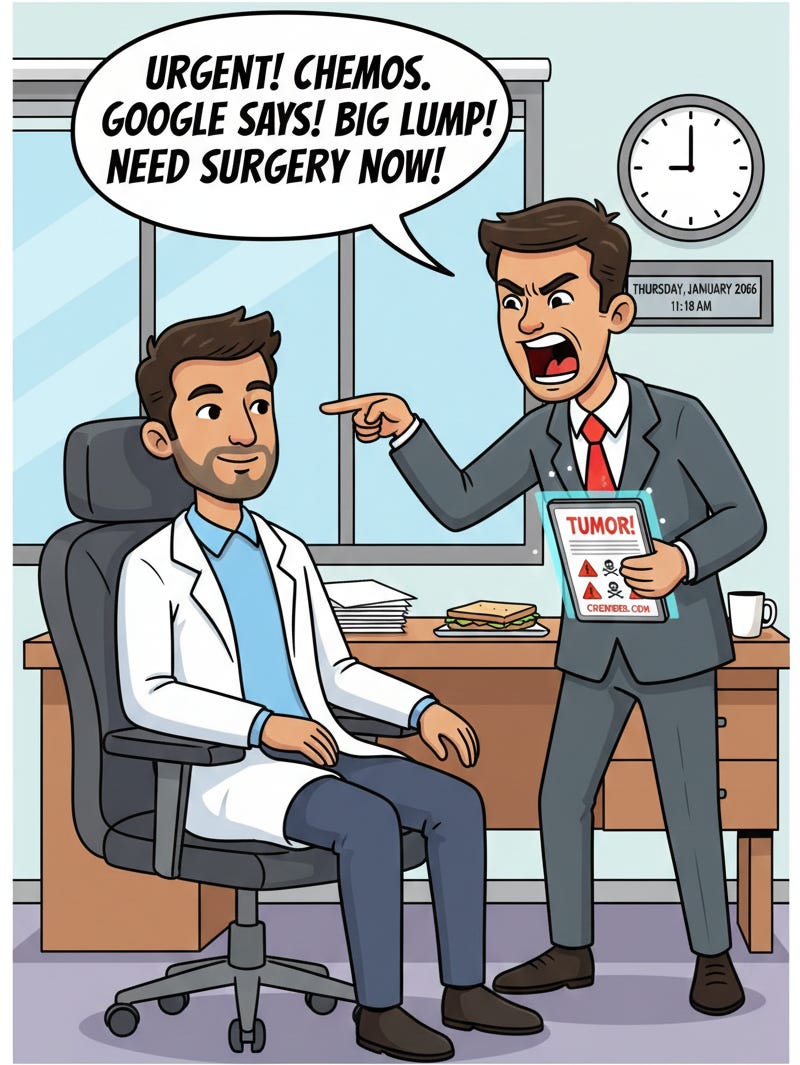
“Sir, it’s only a rash. You don’t need chemo, you need saltwater rinses. Thank you.”
The Google Graduate, as always, goes away mumbling about “ignorant doctors”.
Prashant leans back and decides to take a break. He can’t be away too long so he quickly runs down to the cafeteria for a sandwich. Suddenly, the speakers come alive: “DOCTOR NEEDED IN EMERGENCY WARD!” He’s not worried, urban hospitals usually have multiple specialists on-call 24/7, and someone senior will probably answer. Soon enough, the speakers go silent.
The rest of the day is pretty mundane. See a patient, give a prescription, and frequently rip up the Google MBBS degrees.
Slowly but surely the clock strikes 8 pm. Prashant quietly packs up what has been a long day of work and returns home, prepares dinner, studies a little for his MD, and hits the sack, something not all doctors in the country can afford to do regularly.
A Day in the Life of a Rural Doctor
To understand the life of a rural doctor I interviewed, here are my findings (the source does not wish to be named therefore for the sake of this article we shall name him Shubham).
Shubham starts off his day in his dilapidated house in a small village located in God knows where. Villages like his are not rare, over 18,000 Primary Health Centres (PHCs) across India operate with staff shortages, and many function with only one doctor. Being the only doctor in the village, it’s his responsibility to open his clinic sharp at 6 in the morning. He decides to skip another breakfast and kick-starts his second-hand Activa.
Upon reaching his clinic he is welcomed by a long line of villagers troubled by some disease or another. He apologises for his delay and hurriedly opens the door.
A stream of people rush into the clinic pushing the lanky Shubham out of the way. Screaming at the top of his lungs he is somehow able to settle the villagers down. After strictly saying, “Ek ek kar ke,” he settles down. The villagers come with all sorts of illnesses, from HIV to malaria, from cholera to pneumonia. Rural India still accounts for nearly 90% of malaria cases and a significant share of untreated HIV patients, making Shubham’s workload unpredictable and heavy.
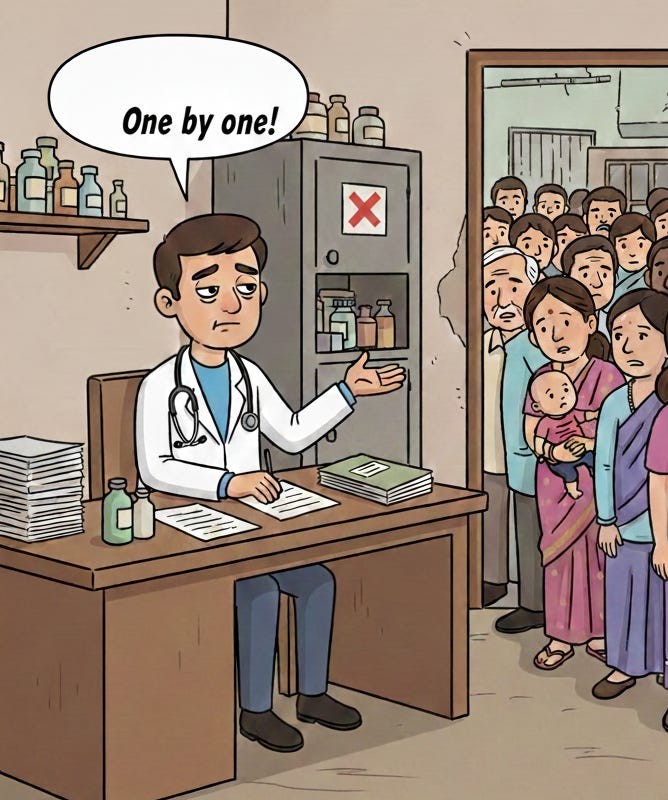
With nervous hands he prescribes medicines to each. His nervousness does not stem from lack of knowledge, but from uncertainty over whether the patients will be able to find the medicines on time. Government data shows that over 30% of rural PHCs face frequent drug shortages, forcing patients to travel long distances for basic treatment.
All of a sudden his worst nightmare comes true.
A mutilated man missing an arm is rushed into his clinic. Blood gushes over his papers and Shubham is uncertain of what to do. He doesn’t have a functioning light bulb or a bed to perform surgery on, conditions that reflect reality, as nearly 60% of rural health centres lack basic emergency infrastructure. So he does what is the best option. Rushing over to the nearest home, he drags a charpai to the clinic and attempts to bandage the man under the bright sunshine.
Tired, he decides to close his clinic to grab lunch at the nearest dhaba. After wafting flies away from the food and waging war on cockroaches, he rushes back.
The line he was welcomed by in the morning has now doubled. Shubham rubs his face and gets back to work. Rural doctors often see over 80–100 patients a day, many of whom arrive late due to farm work or lack of transport. Thankfully, no more mishaps occur. Finally, the clock strikes 12 am. With puffy eyelids, he locks his clinic, kick-starts his scooter, and drives back home.
He has just finished his dinner and is drifting off to sleep when suddenly he is woken by a knock on the door. Grudgingly, Shubham opens it to see a man in distress, a woman in his arms. “Marital rape victim,” he thinks to himself, cases that often go unreported in villages due to stigma and lack of nearby hospitals. Without wasting a second he rushes her back to his clinic and stabilises her just enough to survive the journey to the nearest hospital 25 km away, a distance that can mean life or death when ambulances take hours to arrive.
That night, Shubham doesn’t sleep. Not because he wants to, but because he can’t. Instead, he opens his books and studies for his MD, hoping that one day things might be different.
Conclusion
Prashant and Shubham wear the same white coat, but their realities are worlds apart. Urban doctors work within comfort, structure, and support, while rural doctors shoulder overwhelming responsibility with minimal resources. One deals with inconvenience and routine; the other confronts life-and-death situations daily, often alone. The World Health Organization recommends a doctor–population ratio of 1:1000, yet rural India often falls far below this mark. Until rural healthcare receives proper infrastructure, staffing, and support, the white coat will continue to represent convenience in cities and sacrifice in villages.
A note about the author: Namah is a NEET aspirant. He met two resident doctors, one rural and one urban to see for himself what their lives are like. He was inspired to do this because one of his grandfathers works in a large urban hospital and another in a village. His grandfather connected him to the resident in a rural healthcare center. To connect to the resident in Noida, he was enterprising enough to pay consultation fee, just so that he could talk to him.
Insightful read, Namah!
Lovely insights