

There are moments in a literature classroom when the text seems to take a step back, and the lives of the readers move to the foreground.
A discussion that begins with a poet’s choice of words may lead somewhere no lesson plan could have anticipated. A character becomes a point of disagreement. A metaphor opens up a personal memory. A question about a fictional family begins to sound remarkably like a question about our own.
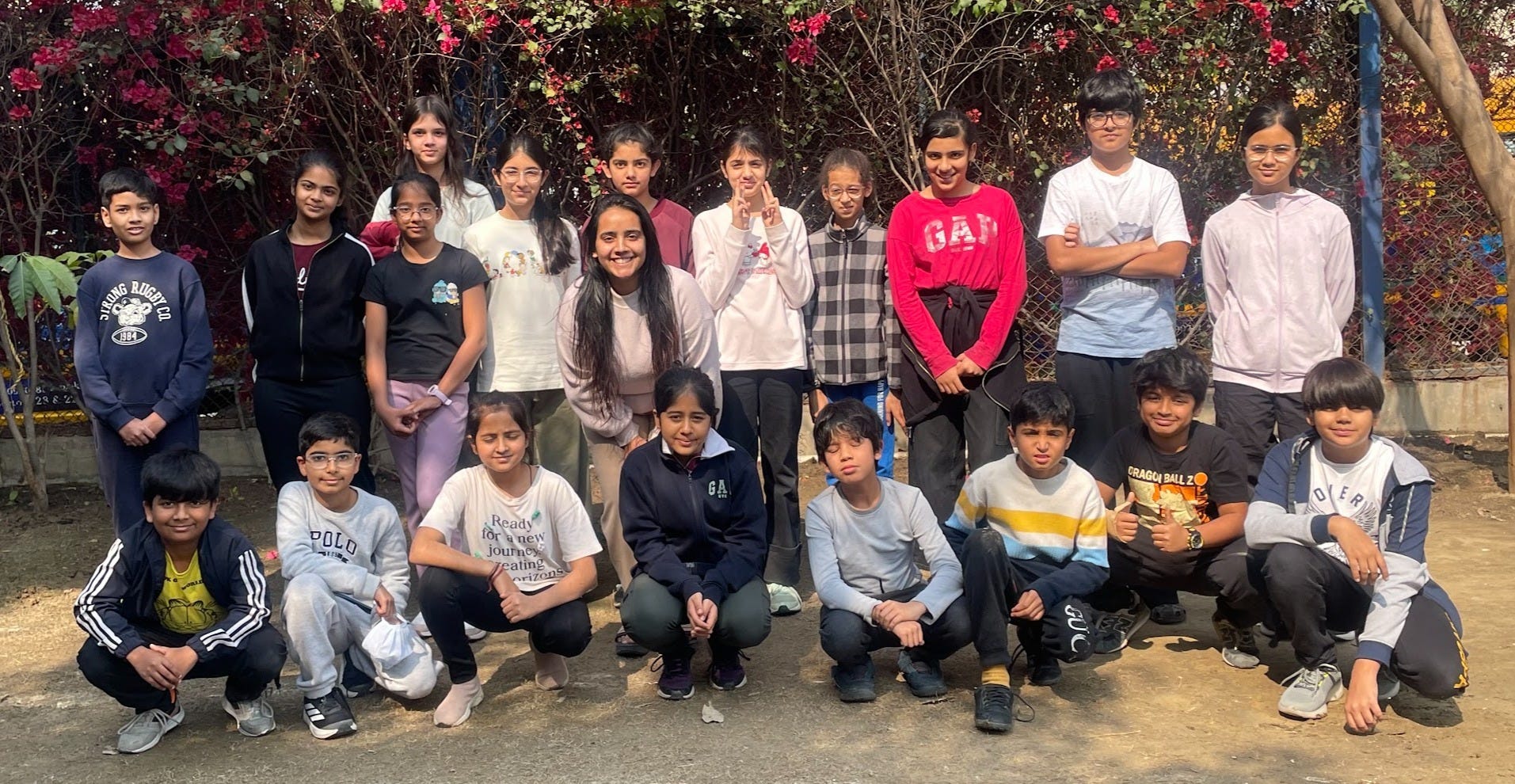
I experienced something of this in our Grade 6, Tenacity classroom while exploring two poems from the Cambridge Stage 7 Learner’s Book.
Both poems spoke of motherhood, but they offered contrasting portraits. Lullaby by John Fuller evoked the tenderness and intimacy of caring for a child, while The Song of the Old Mother by William Butler Yeats gave voice to a mother whose days were consumed by work, responsibility and exhaustion.
The poem ‘Lullaby’ by John Fuller describes a baby sleeping and how the parent feels about their child. Read the poem aloud:
Lullaby
Sleep little baby, clean as a nut,
Your fingers uncurl and your eyes are shut.
Your life was ours, which is with you.
Go on your journey. We go too. The bat is flying round the house
Like an umbrella turned into a mouse.
The moon is astonished and so are the sheep:
Their bells have come to send you to sleep. Oh be our rest, our hopeful start.
Turn your head to my beating heart.
Sleep little baby, clean as a nut,
Your fingers uncurl and your eyes are shut.
Now read another poem. This one is by William Butler Yeats:
The Song of the Old Mother
I rise in the dawn, and I kneel and blow
Till the seed of the fire flicker and glow.
And then I must scrub, and bake, and sweep,
Till stars are beginning to blink and peep;
And the young lie long and dream in their bed
Of the matching of ribbons, the blue and the red,
And their day goes over in idleness,
And they sigh if the wind but lift up a tress.
While I must work, because I am old
And the seed of the fire gets feeble and cold.
We began by reading, interpreting and comparing the poems. But soon, the conversation moved beyond the page.
Could motherhood be tender and exhausting at the same time? Did the mothers in the poems resemble the mothers the learners knew? If they were to write a poem about their own mothers, which of these voices would they hear?
The responses came readily.
“She would think like the mother in the second poem.”
“My mum is also always working.”
“My mum is also the first one to wake up in our home.”
Another learner felt that their mother spoke to them much like the mother in the first poem.
What interested me was not whether these comparisons were accurate. It was how readily the children drew upon their existing ideas to make sense of what they had read. They were not approaching motherhood as an unfamiliar concept. They already had a picture of it, assembled from routines, relationships, conversations, observations and perhaps things they had heard adults say.
The poems had given us an opportunity to examine that picture.
And so, instead of bringing the discussion to a neat conclusion, we decided to follow the questions further.
From reading about motherhood to investigating it
I wanted the learners to move beyond what they believed motherhood looked like and investigate what they could actually observe.
After analyzing the two poems, learners wrote poems from their mothers’ perspectives, imagining how their mothers might see them. Sharing these poems opened up conversations about relationships, emotional tone and the assumptions we make when attempting to understand another person.
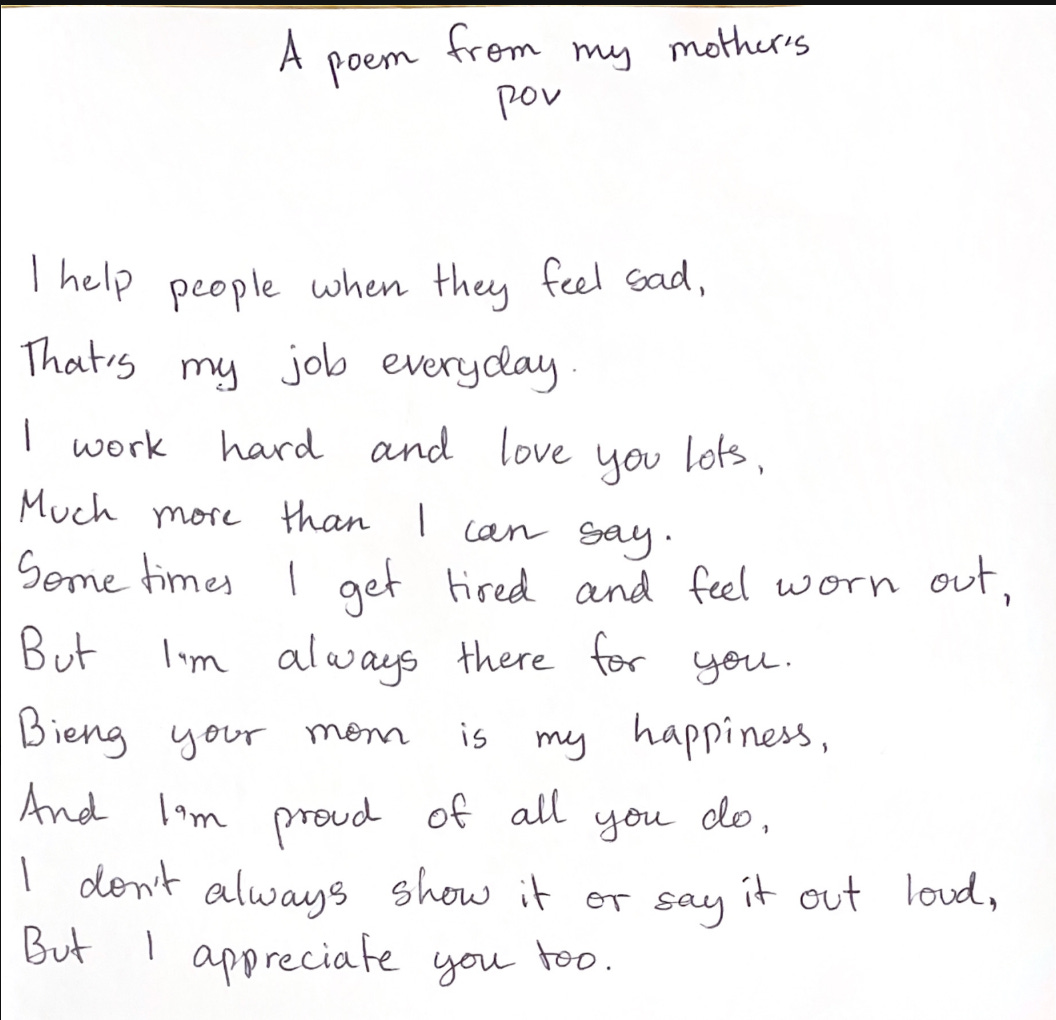
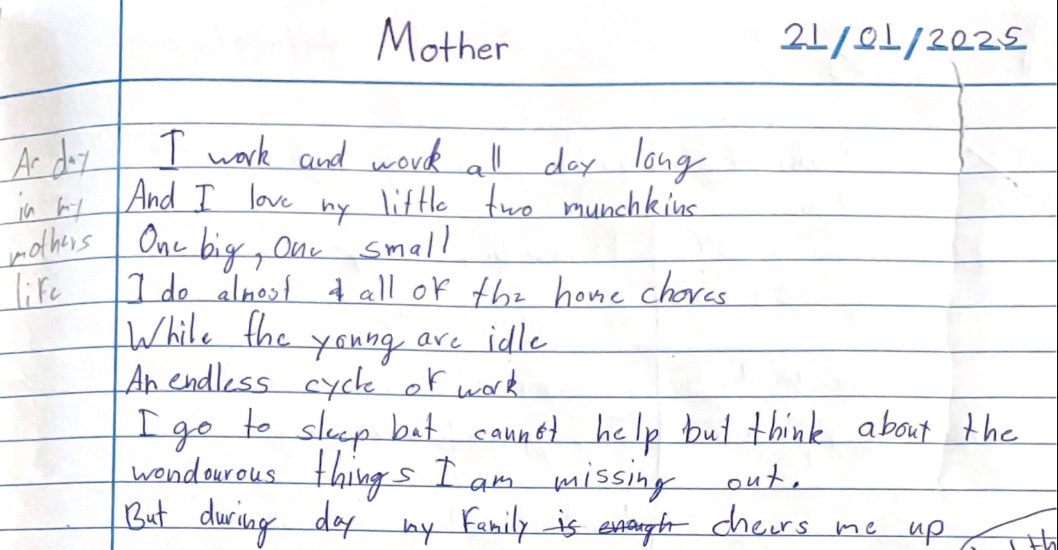
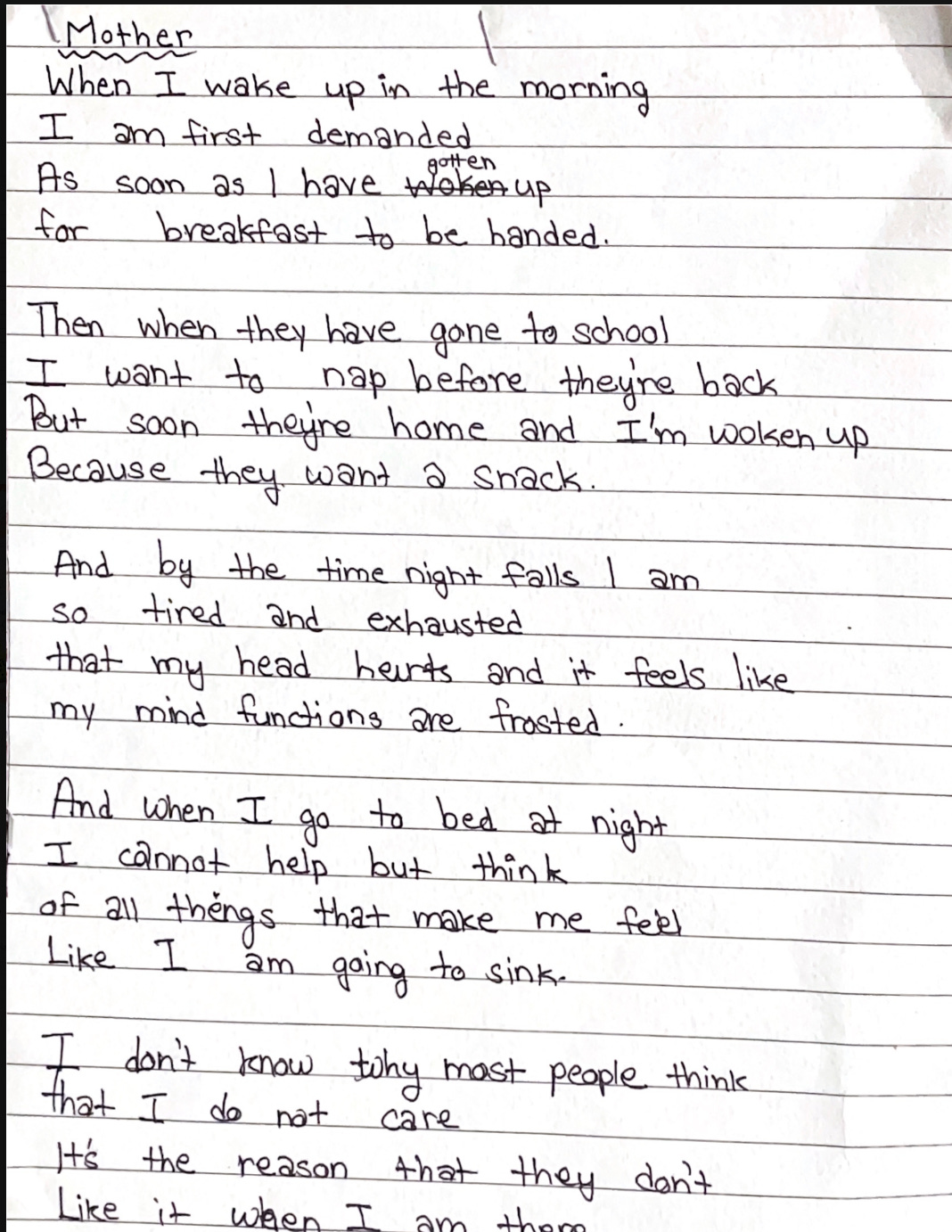
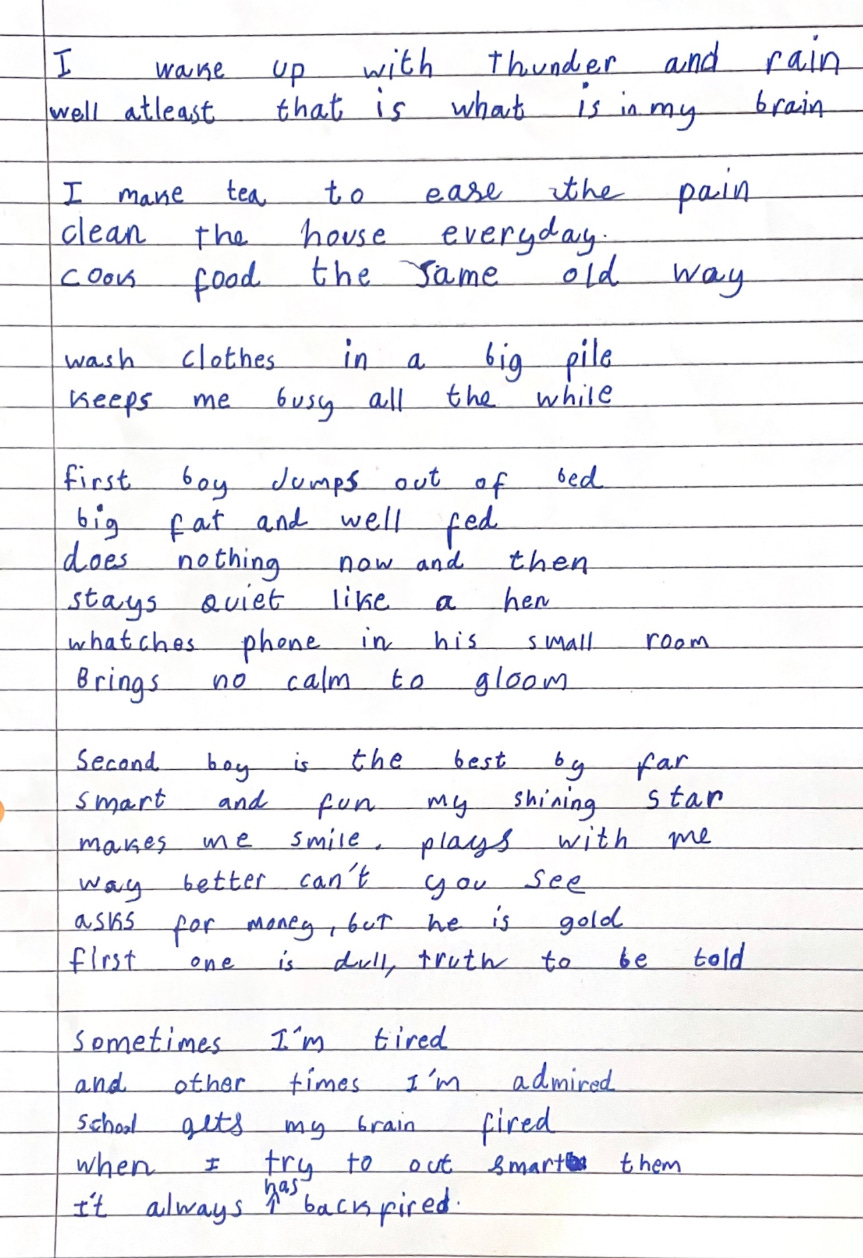
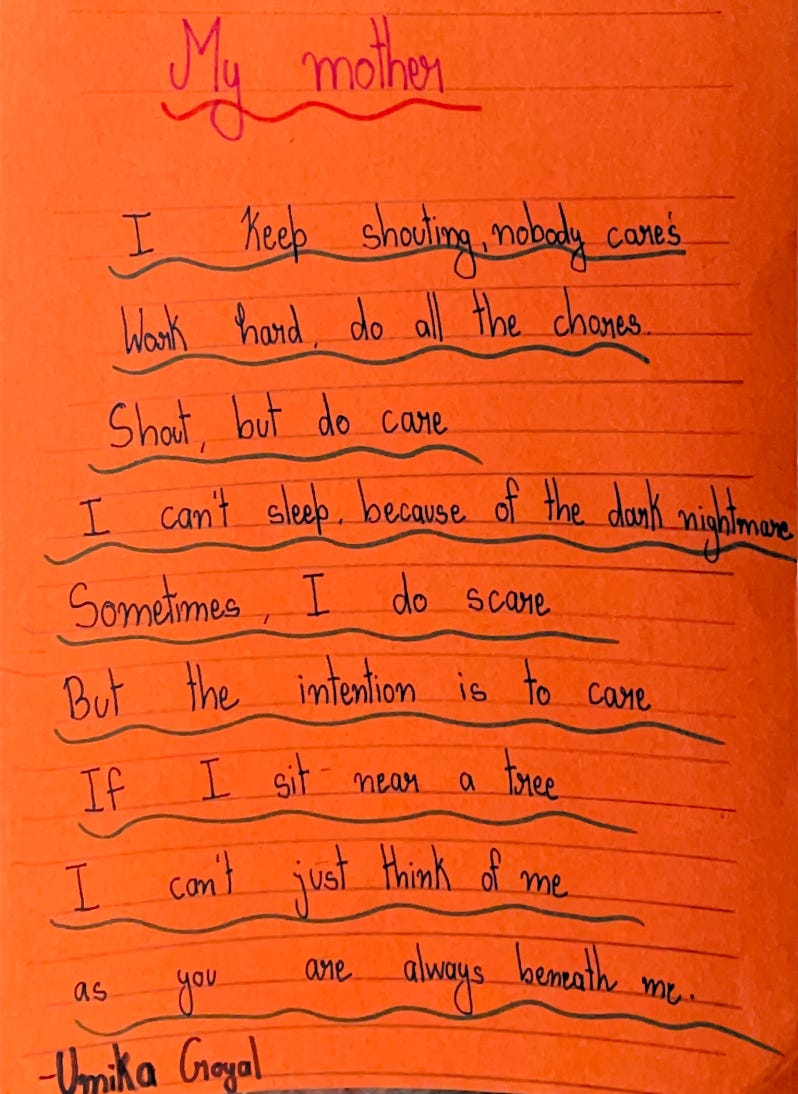
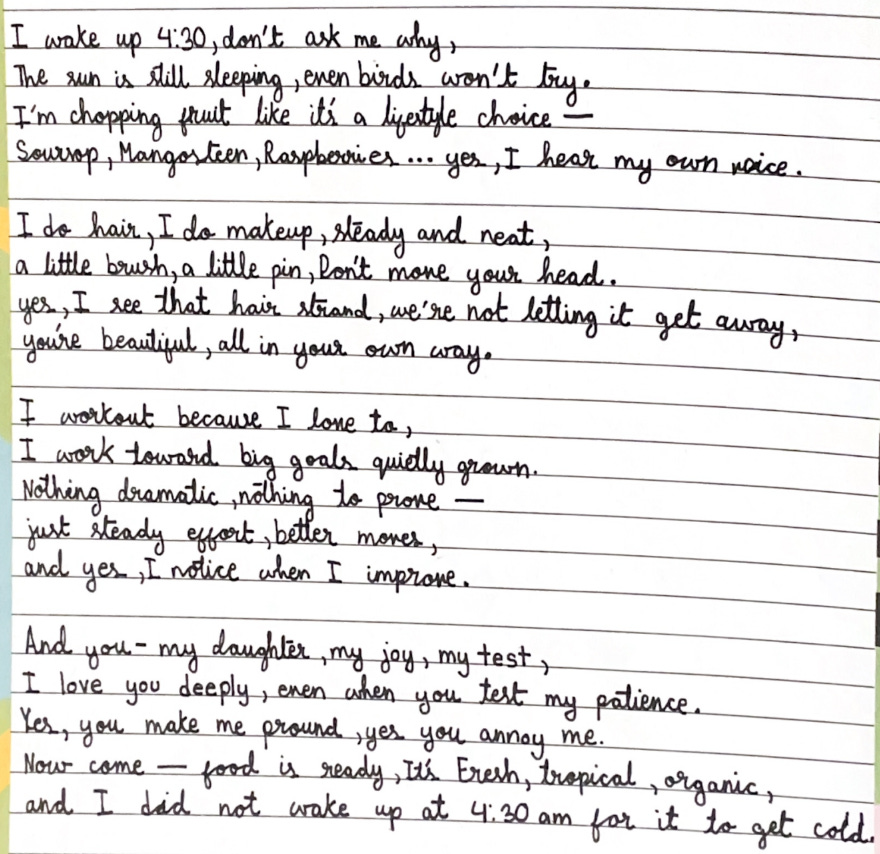
One learner shared a lighthearted poem imagining their mother spending her time lounging on the sofa and eating chips.
It made us laugh, but it also opened up an interesting possibility. Did our understanding of a person leave room for the ordinary pleasures, idleness and interests that had nothing to do with their responsibilities towards us?
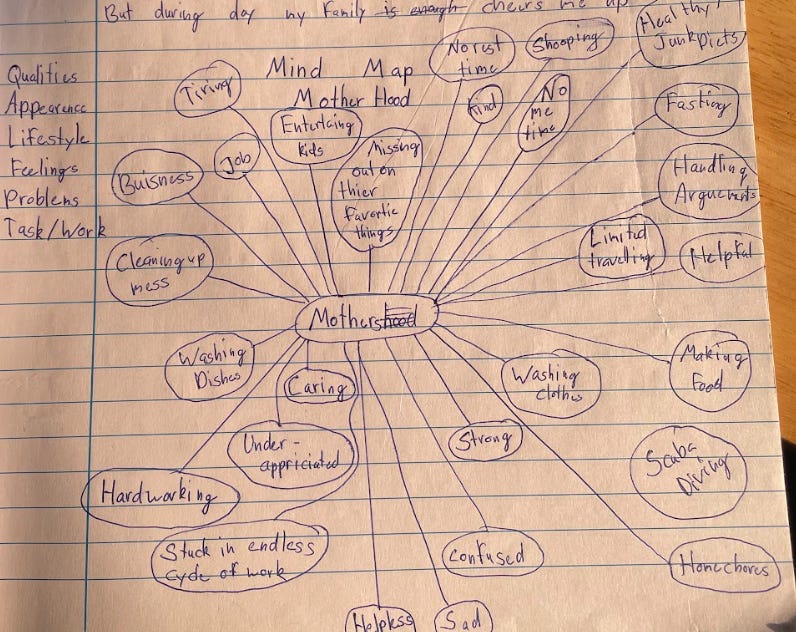
Then we went on to make mind maps on the theme of ‘motherhood’. What did learners associate with motherhood? What activities, qualities, emotions, relationships and responsibilities came to mind?
Their responses were revealing. Household chores, cooking, kindness, caregiving, helping children, solving problems and mediating arguments appeared repeatedly.
Many spoke of mothers putting their children’s needs before their own. Some reflected on the friendships and relationships mothers maintained, while others wondered about the things mothers might give up after having children.
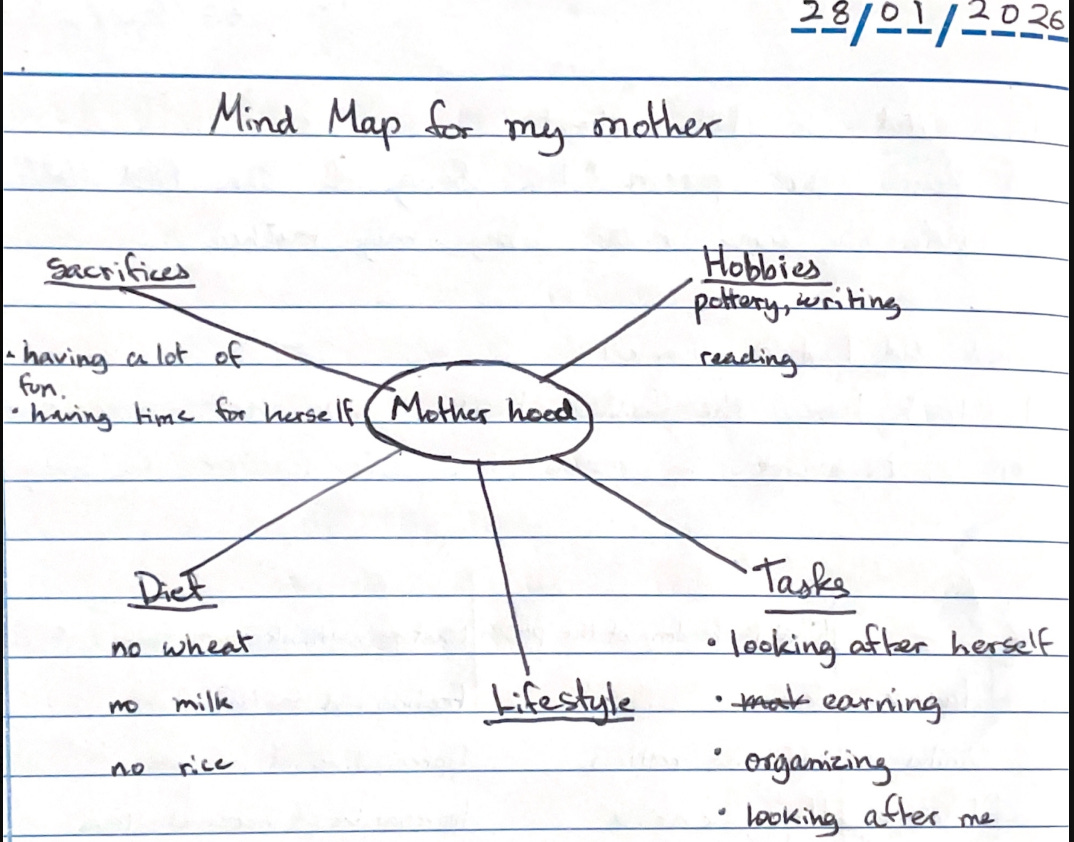
Our conversations were full of appreciation, but they were not entirely uncomplicated. Some learners spoke about sacrifice as though becoming a mother necessarily meant giving up parts of oneself. Others wondered whether mothers might feel envious of the freedom their children enjoyed. These were not questions I wanted to rush to answer. I wanted us to become more curious about them.
What happens when we describe a person almost entirely through what they do for others? Can admiration, even when genuine, sometimes make it harder to see the person behind the role?
The next step was to look more closely.
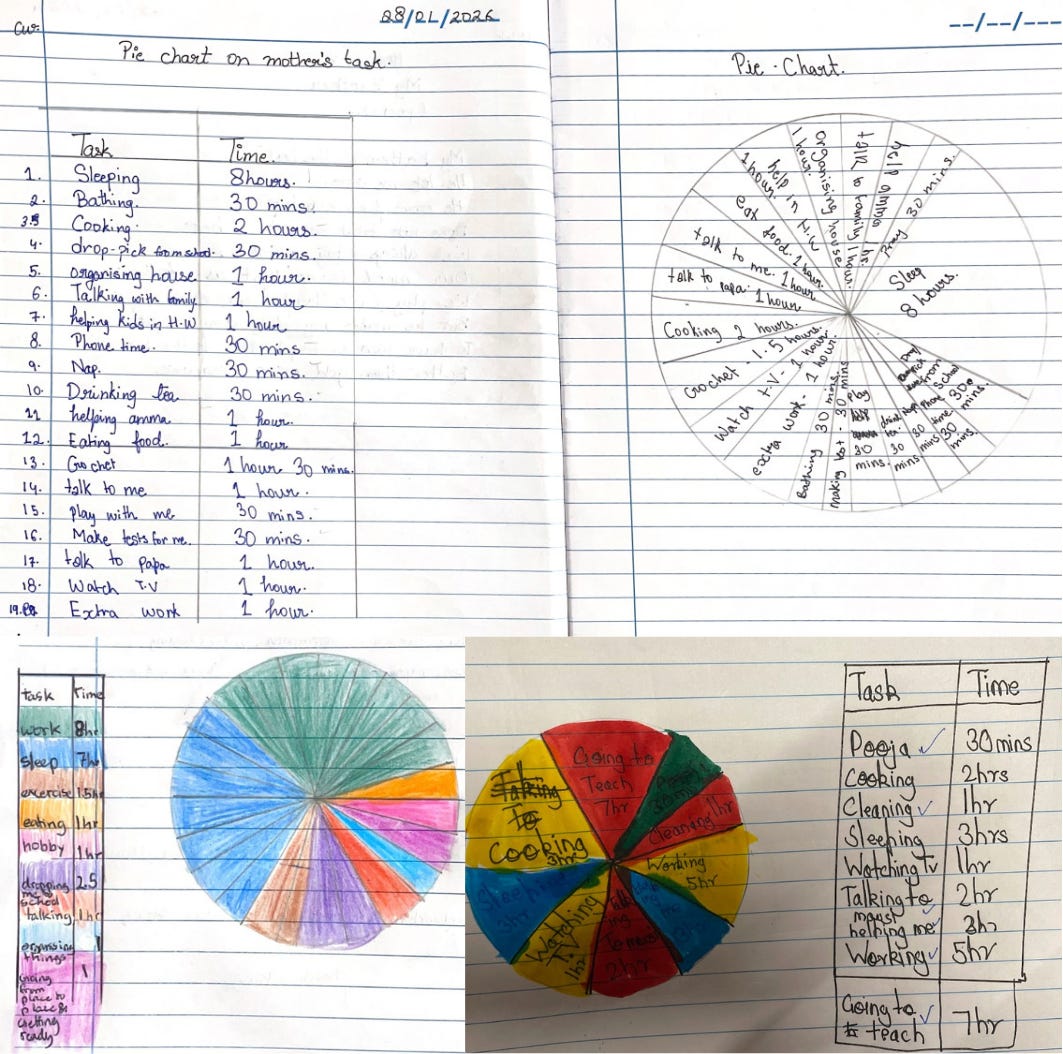
The learners were invited to shadow their mothers through a day, interview them about their routines and record the time spent on different activities. They would then represent this information in pie charts and examine the patterns emerging from the data.
Literature had given us a starting point. Now, it was time to look beyond what we thought we knew and begin asking questions.
What a pie chart can—and cannot—tell us
The time-use activity introduced a different kind of challenge.
Initially, many learners found it difficult to account for a complete day or estimate the time spent by their mothers on different activities. Some recognized that their mothers’ routines changed from day to day, making a single, representative schedule difficult to construct.
Their charts included cooking, household responsibilities, paid work, exercising, talking to relatives, religious practices, caring for pets, helping children with their studies and spending time with family. A few included hobbies such as crochet. Others recorded less flattering or more humorous observations, including the time their mothers spent “screaming at us”.
Yet certain activities were conspicuously absent or difficult to account for. Sleep, meals, planning, rest and the coordination of household responsibilities did not always receive the attention one might expect. Some learners were trying to reconstruct hours of the day they rarely witnessed because they were at school.
This raised a question that seemed as important as the charts themselves: how much of another person’s day can we really know from what we see?
When the learners exchanged their charts, the activity became even more interesting. They compared common activities, identified the tasks that occupied the greatest and least amounts of time, and checked whether the figures added up to twenty-four hours.
They also questioned one another’s findings.
Was four hours of screen time plausible? Could a mother really spend only an hour scolding her children? Had everything been accounted for? How had the learner arrived at these estimates?
One observation particularly stayed with me. Aarav reflected that the earlier mind maps had made mothers’ responsibilities seem almost exaggerated, whereas the pie charts offered a more proportionate picture.
It was a small but meaningful shift: a recognition that the way we represent an idea can influence how we understand it. Not to trivialize the intensity or importance, or experience of that activity.
The charts also brought us to questions about evidence. Were the figures based on direct observation, estimates or what mothers had reported in interviews? Could a single day tell us anything reliable about a person’s routine? Might the way a question is asked influence the answer?
The data was imperfect, as data collected in everyday life often is. But that imperfection became part of the learning.
We were no longer simply asking what mothers did. We were asking how we knew what we thought we knew.
Beyond the idealized image
Perhaps the most significant learning emerged when the children encountered experiences different from their own.
One learner was surprised to discover that a peer’s mother regularly went to the gym. Another encountered a family in which the mother was the sole earner. Some heard about mothers who travelled frequently for work; others discovered routines and relationships they had never imagined.
These differences mattered because children were beginning to encounter motherhood not as a single, shared experience, but as something shaped by individual circumstances.
The conversations also challenged the tendency to see mothers only through familiar descriptions: loving, caring, hardworking, selfless. These qualities may be sincerely felt and deeply valued. But a person can be caring and frustrated, devoted and ambitious, generous and still in need of rest. A mother can love her children while retaining interests, friendships, identities and desires that exist beyond them.
The inquiry was not about replacing one portrait of motherhood with another. It was about making room for more than one truth.
That distinction became particularly important when conversations grew emotionally complex. Because the inquiry touched learners’ own homes, I had to remain attentive to the different experiences being brought into the room. We needed a space where learners could share without being judged, where difference did not become a reason for comparison, and where a child’s observation did not have to be treated as a definitive account of a parent’s life.
The task was not to decide whose mother worked hardest, whose routine was most demanding or whose family resembled the poems more closely. It was to listen, notice and ask better questions.
When reflection becomes part of the learning
Towards the end of the inquiry, the learners wrote reflective essays about their understanding of motherhood and whether it had changed. Many moved beyond describing their own mothers to consider broader ideas about caregiving, sacrifice, stereotypes and invisible labor. They drew on family conversations, observations, classmates’ experiences and insights gathered through the earlier activities.
Some began noticing everyday acts of care differently. Others recognized assumptions they had previously taken for granted. Their writing did not produce a single conclusion, nor did it need to. What mattered was the movement in their thinking: from an initial impression to an observation, from an observation to a question, and from a question to a more considered understanding.
I, too, was learning alongside them…
After each session, I documented not only the ideas learners expressed but also the atmosphere in which those ideas emerged. I paid attention to recurring themes, moments of laughter or silence, unexpected comments, contradictions and questions that remained unresolved. I found myself asking: What feels culturally familiar here? What seems genuinely new to the learners? Which activities have prompted them to reconsider their assumptions? Where might I, too, be interpreting their responses through my own expectations?
The documentation helped me look beyond individual answers and notice how thinking shifted across the inquiry. It also reminded me that facilitation is not simply the art of guiding learners towards a destination. Sometimes it means resisting the urge to supply an interpretation before the group has had time to develop one.
My responsibility was to provide the structure, resources and emotional safety that would allow the inquiry to unfold, while remaining open to where it might lead.
What we learn when we look again
Looking back, this project became much more than an exploration of two poems. Literature opened the door, but the learning moved across creative writing, interviewing, observation, data representation, discussion and reflection.
Each method helped us see something different. The mind maps made associations visible. The time logs brought attention to daily routines. The pie charts raised questions about proportion and evidence. Conversations introduced experiences beyond our own. Reflective writing gave learners a space to make sense of what had changed.
Together, these experiences showed me the value of returning to a familiar idea through different lenses. Understanding rarely deepens through a single activity or a well-delivered explanation. Often, it develops when we have the time and tools to revisit what we thought we understood. Perhaps this is one of the possibilities of teaching literature: not merely to help learners interpret the worlds writers create, but to help them examine the worlds they inhabit.
The two poems did not give us a final definition of motherhood. Nor did our inquiry settle every question about care, work or family life. Instead, it made the subject more complex, more human and more worthy of attention. And perhaps that is a worthwhile purpose of education: not always to leave a classroom with certainty, but to leave with a more careful way of looking.
What else might we begin to understand if, instead of asking children to accept familiar ideas, we invited them to investigate how those ideas came to be?