

Deep Learning History
History can be learnt by covering its breadth across nations, time periods or diving deep into a thematic area and making connections with its emergence and creating new knowledge for the community. Ultimately, the right fit in a study cohort depends on its research readiness, base knowledge for critical thinking and independent working.
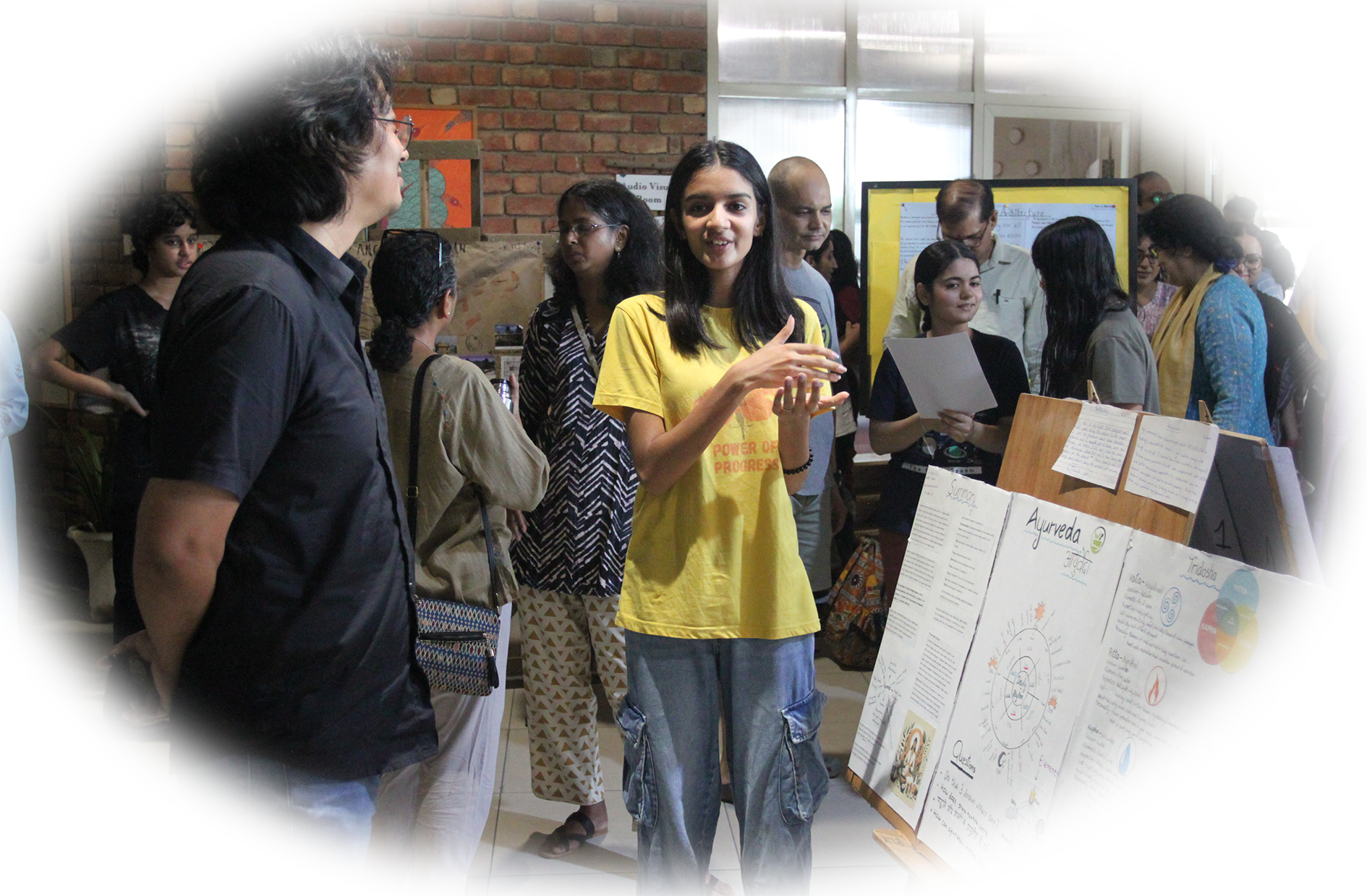
We centered World History studies in Grade 8 on KNOWLEDGE- its origin and proliferation. The first of this had to be the spread of knowledge from ancient India to the rest of the world.
"A comprehensive understanding of Indian history isn't always readily accessible, and this can influence how individuals view their own identity."
We sought to create a learning experience that acknowledged and valued the diverse contributions of various cultures, moving beyond a Eurocentric perspective.
The project unfolded in two phases. The first focused on India's contributions to fields like performing arts, mathematics, astronomy, medicine, philosophy and belonging to environment. Learners weren't simply told stories. Instead, they chose a topic that sparked their interest from a well-researched Grade 11 NCERT textbook (a 2012 edition featuring contributions from scholars like Kapil Kapoor and Michael Danino). For this, the learners’ choice was crucial as it immediately gave them ownership of their learning.
Armed with their chosen chapter (around 40 pages), learners embarked on independent research, diving deep into their chosen subject. They wrote summaries, formulated research questions, and then chose one to explore in a more in-depth essay. The learning process was as important as the final product. "If they came back and told me, 'I don't understand this, can you give me another book? For me, this curiosity deserves extra marks," Vidya Didi, their IGS facilitator shared, emphasizing the importance of active inquiry.
But the learning didn't stop there. Learners created visual galleries to share their findings with their classmates and parents, fostering peer learning and sparking conversations beyond the classroom. They then presented their research, further developing their communication skills. Finally, they reflected on their learning journey, solidifying their understanding and identifying key takeaways. One learner, for example, discovered the practical applications of Ayurveda in daily life, while another traced the origins of modern mathematics back to ancient India.
The second phase of tracing the history of knowledge delved into the Renaissance period. To study this important period of world history, the students chose a figure that intrigued them – be it a scientist like Newton or Vesalius, an an artist like Michelangelo or Rembrandt, or a thinker like Machiavelli.
The group discussed the translation of texts into Latin and the influence of these ideas on classical Greek and Roman thought, which were rediscovered during the Renaissance. The role of trade and wealth in this period was also explored. Individually, the students documentaries, analyzed original books, other sources, and then connected it to the Renaissance, explaining how knowledge from India, transmitted through the Islamic world, might have played a crucial role in fueling the European intellectual and artistic revolution. They presented their findings on charts and presented to their peers. Click here to watch our learners share their journey of learning.
Students, in groups, were tasked with designing a "school" that embodied the values and ideas of their chosen Renaissance figures. One group, inspired by Robert Boyle, designed a school with a state-of-the-art laboratory where learners were encouraged to experiment and explore. This experiential learning allowed them to truly "get under the skin" of these historical figures, understanding their motivations and contributions on a deeper level.
More than just learning facts, the projects helped learners discover that history isn't a collection of isolated events; it's a tapestry woven from the threads of diverse cultures and eras. These projects, bridging ancient India and the Renaissance, demonstrated that the pursuit of knowledge is a global and timeless endeavour.
“I learned a lot in IGS, but what really stayed with me were the chapters on India's gifts to the world, the Natya Shastra, the Survey of Duties, and the Renaissance project. I was eager to engage in a more in-depth analysis and exploration of the last few chapters, like the stories of Raja Dahir, the empires of India, and William Hastings, as I felt there was much more to learn. These units taught me a lot; they gave me clarity and insight into the world wars. I learned skills like source analysis, researching, and public speaking. Through this course, I discovered how important it is to take proper notes, practice essay writing, and maintain a consistent and organized study schedule for IGS.”
"We explored a wide range of Indian history, from the Battle of Plassey and the story of Raja Dahir to the rich traditions of the Natya Shastra. I was particularly fascinated by the empires of India and the incredible developments in the Islamic empire. The Renaissance project taught me about the history of science and daily life during that period. The chapter on colonization taught me how Europeans invaded India."
“Working on these projects had a significant impact on me. Learning about the remarkable individuals whose research and inventions shaped our world sparked my curiosity and expanded my knowledge. Through this process, I honed several important skills, such as surveying, researching, chart making, and maintaining organized notes."
“It helped me get a good idea of the history of India, I also understood many western stages like Renaissance, Spanish trade and translation from Arabic to common languages. The skills that I picked up while working on these projects were Documenting, note-making, essay writing, source analysis and summarizing learning/findings.”
“This project significantly broadened my understanding of Indian history. I also gained valuable insights into key Western historical periods, such as the Renaissance, the Spanish trade routes, and the translation of knowledge from Arabic to common languages. Through these projects, I developed essential skills in documenting information, note-taking, essay writing, source analysis, and summarizing my learning and findings.”
-Reflection of the learners