

Social Sciences at Prakriti is called Indian and Global Studies for a reason.
The middle school learners must learn to appreciate the legacy of ancient India for the rest of the world and its constitution before moving on to global history knowledge and current perspectives. ‘Studies’ because it is carried out through research projects that encourage individualised deep learning, creativity and reading diverse sources.
Grade 7 Dives into Maurya, Gupta and Chola Empires to understand their legacies to the world
Recently, our Year 7 learners embarked on a fascinating exploration of ancient Indian empires with the oldest, Mauryan empire. They didn't just read about the Mauryans; they became them. Under the guidance of Neha Mandal, they delved into the intricacies of Mauryan society, from its complex administrative system and diverse religious landscape to its rich artistic and cultural traditions.
This immersive experience culminated in a truly unique project: the learners themselves wrote, produced, and performed a play about Chandragupta Maurya for the entire school. This theatrical experience wasn't just entertainment; it was a powerful way for them to synthesize their knowledge and share it with the community.
Building on their understanding of the Mauryans, the learners then embarked on independent research projects on the Gupta and Chola empires. They chose from a broad range of research questions or legacies— shipbuilding, temples, trade, religion, literature, medicine, astronomy, math and selected an area that truly sparked their curiosity.
The facilitator provided resources and guidance, but it was the learners' own passion that drove them to explore beyond the confines of the classroom.
What began as a simple research task quickly evolved into in-depth investigations and genuine exploration, with learners asking insightful questions, connecting historical events to modern-day issues, and demonstrating a real thirst for knowledge.
One student, fascinated by astronomy, researched the advancements in Gupta-era mathematics and compared them to modern-day scientific methods, discovering surprising parallels. Another explored the intricate network of trade routes that sustained the Chola empire, creating a detailed map of the Indian Ocean trade and analyzing its impact on the region.
The facilitator observed significant growth in the learner' research and analytical skills. They learned to evaluate sources, identify bias, and construct well-supported arguments. Even students who were initially hesitant to speak in class gained confidence through presenting their research.
"It was amazing to see them immerse themselves in the stories of the empire. The play wasn't just a performance; it was a culmination of their learning, a way to make history tangible and memorable."
-Neha Mandal (IGS Facilitator)
Sindhu-Saraswati (Indus Valley) Studies by Grade 6
For our younger learners in Grade 6, the IGS Projects provides a bridge from primary to middle school. Learning from virtual and physical museums and archaeological sites, introduces them to the disciplines of History in an engaging and accessible way. The facilitator describes how these learners explored human evolution and the transition to settled farming, sparking discussions about our own modern lifestyles and prompting them to consider the long arc of human history.
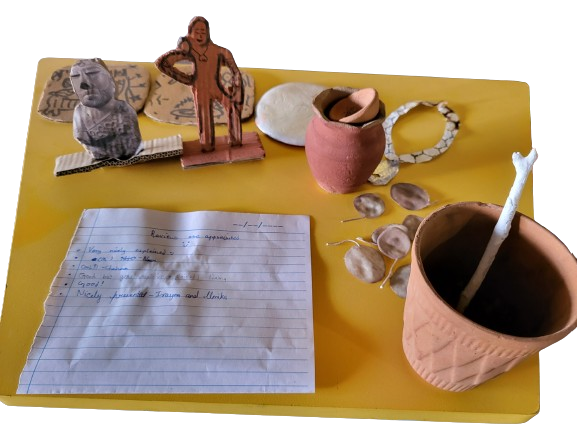
Welcoming this cohort from Grade 5 presented an opportunity as well as a challenge. Having previously studied Environmental Studies, a blend of Science and Social Science, these young learners were now being introduced to the distinct discipline of History. Understanding timelines, structured research, and the very concept of historical evidence proved challenging at first. However, with guidance and encouragement, the class gradually began to engage in deeper conversations about the topics they studied. Logical questions emerged, signifying the development of critical thinking.
The curriculum began with human evolution, exploring the social, cultural, and cognitive development associated with each stage. The transition from hunting and gathering to settled agriculture sparked discussions about our own modern modes of subsistence, particularly relevant in the learners' urban context. Connecting the past to the present and questioning our current state of existence is a key objective of history education, and witnessing this connection being made was a rewarding experience.
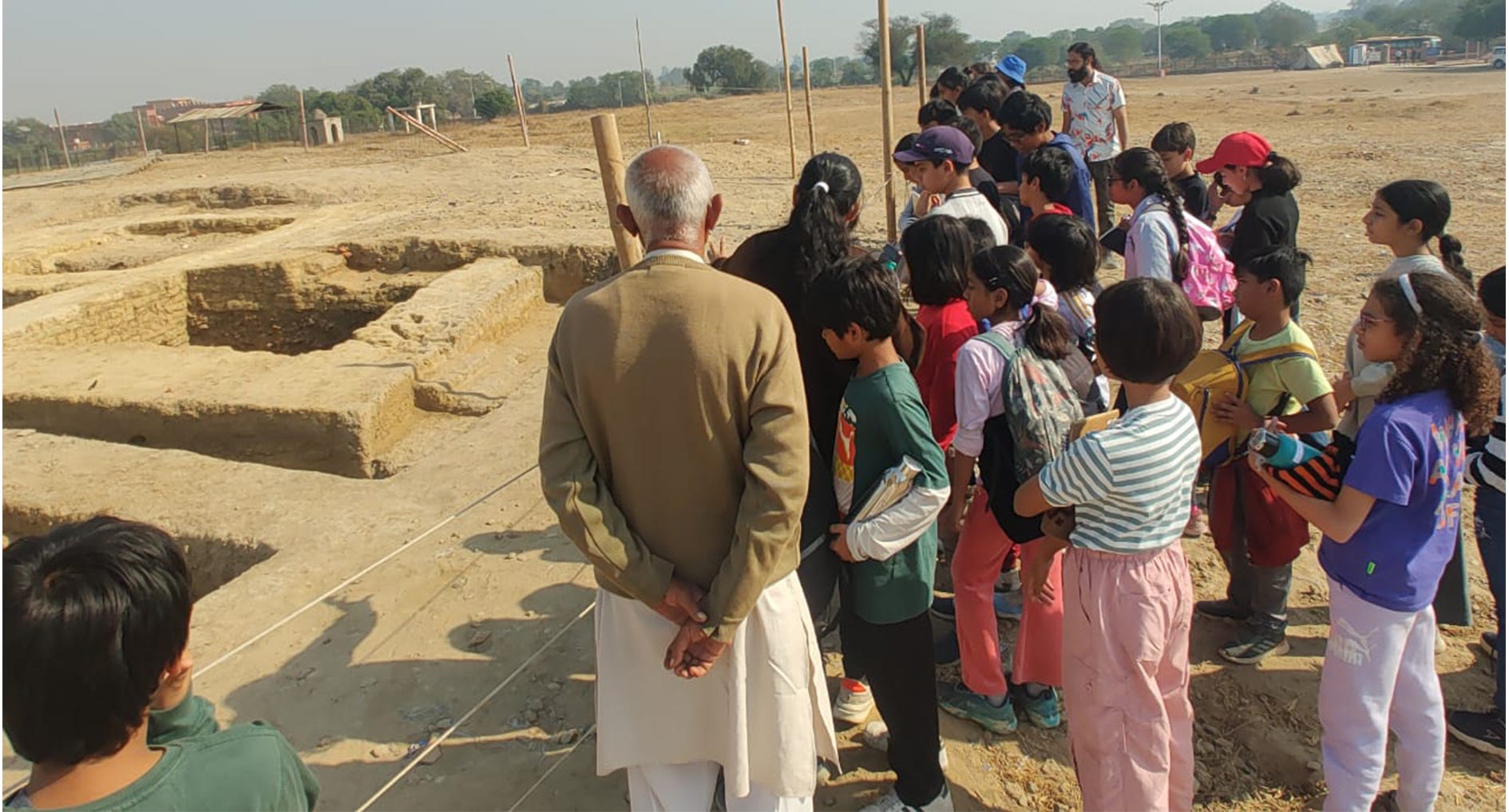
Another immersive experience for the learners was visit to Rakhigarhi, an archaeological site, 200 kms from Delhi, with most recent discoveries of ancient remains. The visit was supported by Archaeological Society of India (ASI) team and made the evidence analysis real for the learners.
Following a visit to national museum and with the study of artefacts, and exploration of the Harappan civilization through textbooks and multimedia resources, the learners embarked on a project to curate their own gallery. They recreated Harappan jewellery, pottery, seals, models of grid-pattern town planning, and even the iconic "dancing girl" figurine. The module on trade included boat replicas, while the section on burial practices featured information on pot burials and the skeleton found at Rakhigarhi.
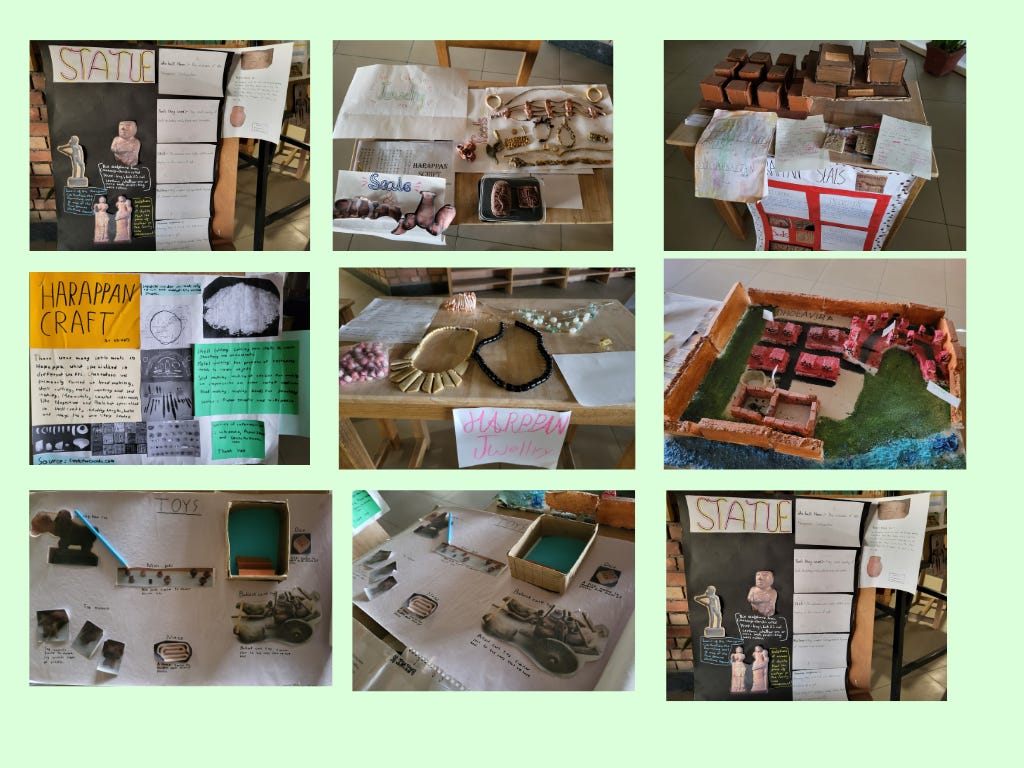
Explaining their gallery to visitors, the learners demonstrated a deep understanding of the Harappan period. They discussed bronze-making techniques, the sophisticated drainage systems in Harappan towns, and various burial practices. They also began to form their own informed opinions, speculating about modern burial practices and urban planning. This ability to connect the past to the present marked the beginning of "new knowledge" creation – a knowledge that these future leaders will continue to build upon, refine, and reshape.
"The function of the historian is neither to love the past nor to emancipate himself from the past, but to master and understand it as the key to the understanding of the present.” E.H. Carr