

Dialogue as a way of inquiring into the human condition
has long been a recognized method both in the Western (ancient Greece) as well as the Eastern (Purva-paksha) civilizations. Throughout history, there have been efforts to suppress dialogue, and so at Hocokah, it was our attempt to rekindle that process by laying bare its very essence: listening.
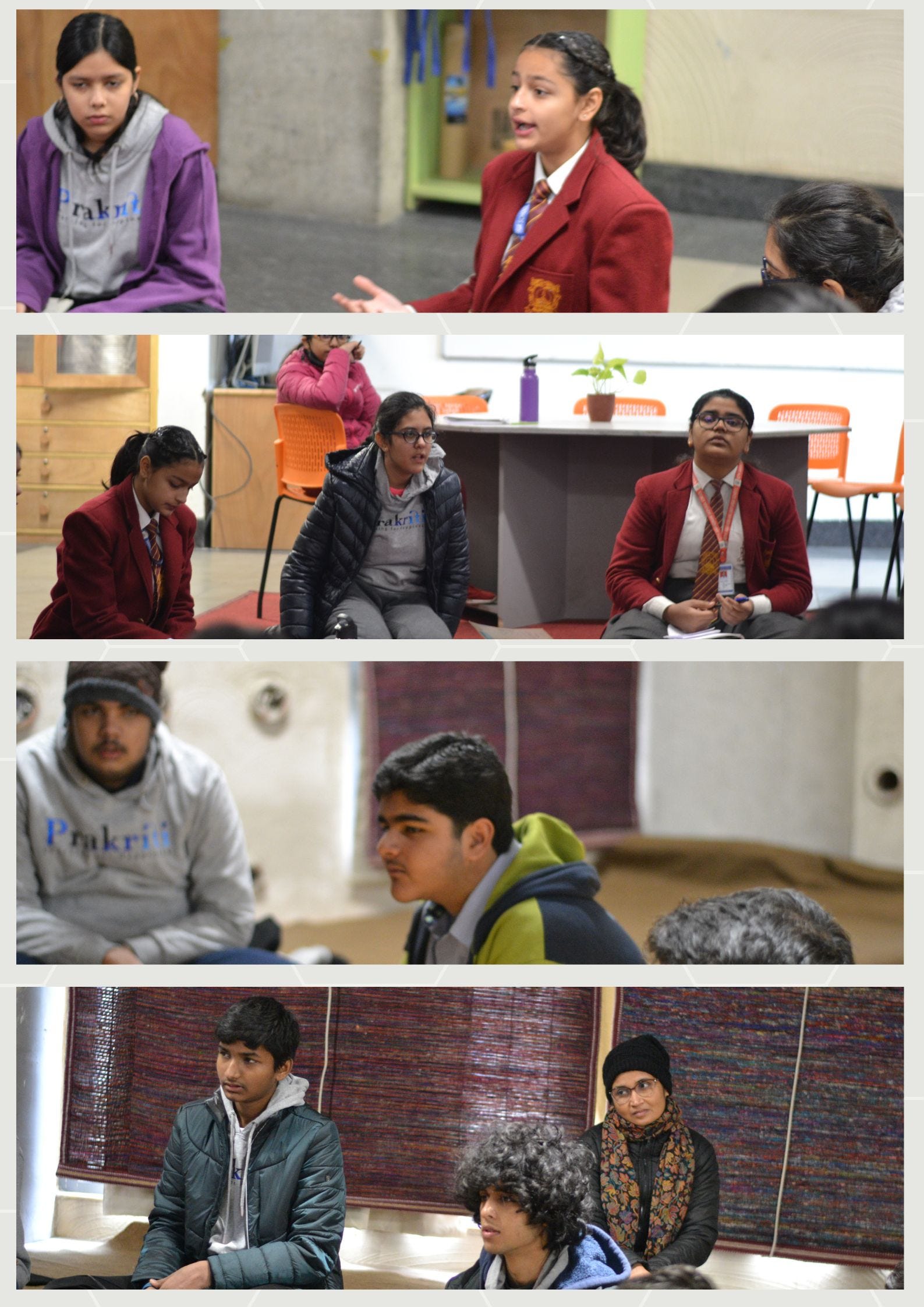
It was really inspiring to see young minds..
from Grade 8 to 10 from Shiv Nadar School, Noida & Gurugram, The Mother's International School, Delhi & Seth M.R. Jaipuria School, Ghaziabad and Prakriti participating in and contributing to a series of dialogues on various themes.
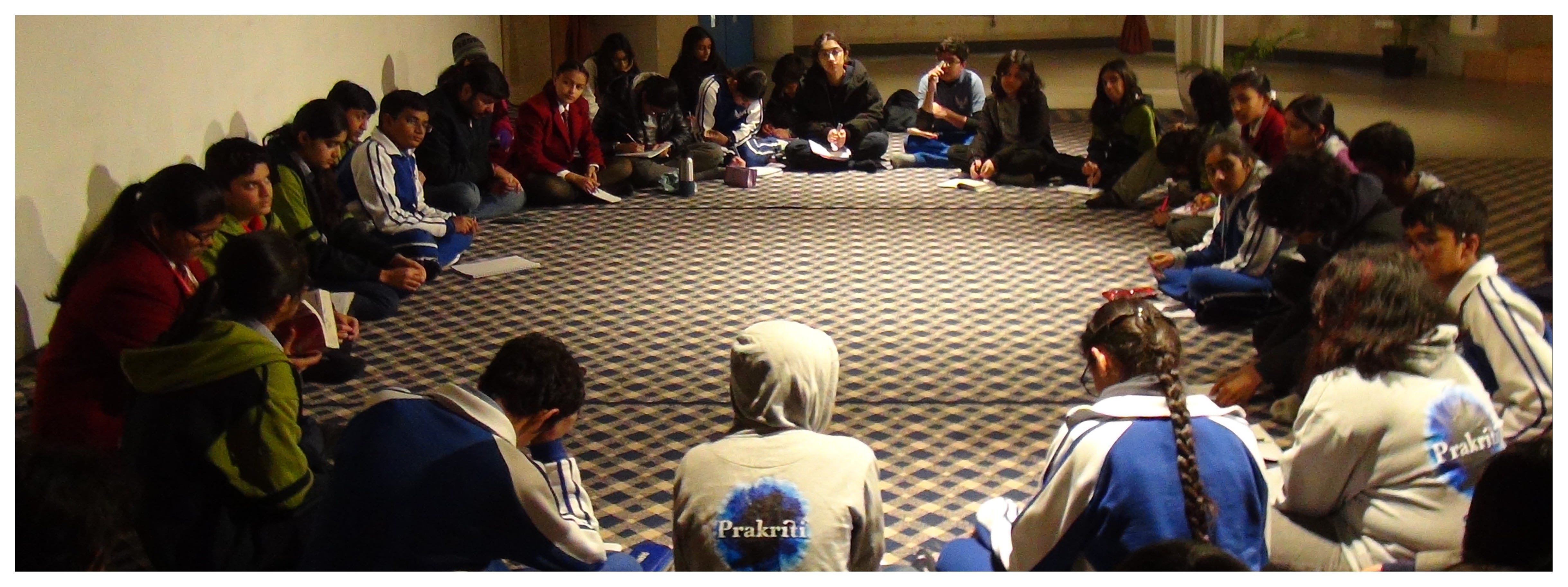
The event was built on a non-competitive method, combined with a focus on investigation of questions raised by the participants themselves, which formed the basis for creating the process of dialogue.
The facilitators and participants had previously engaged in dialogue twice over questions of ‘violence’ and ‘inequality’, along with the multiple readings shared with the participants which set the context for the final day at Prakriti on 19th January.
On the day of the event participants were divided into 4 groups and each of the groups was given a challenge to start a dialogue on. The statements were:
I. Violence is a balancing force of nature.
II. Free will is an illusion.
III. Comparison is necessary for progress.
IV. Modern people, you and me, are religious too, just that our objects of worship are different.
Here is brief of the discussions that took place
Violence
The group that delved into the topic of violence explored the complex relationship between violence, human nature, and nature's balance. They debated the necessity of violence in maintaining equilibrium, scrutinized historical events like World War I and II, and pondered the subjective nature of violent actions. The conversation also delved into humanity's place within nature, examining the interplay between survival needs and desires. This rich dialogue prompted reflections on the multifaceted dynamics of violence, human behavior, and our connection to the natural world.
Free will
In the free-will group, participants discussed the definition of free will and its relationship with societal influences and personal emotions. They questioned the control over human nature, accountability for self-imposed limitations, and methods to break free from emotional chains. The discussion underscored the complex interplay and the intricate balance between societal norms, personal emotions, and individual agency.
Comparison
In the comparison group, participants delved into the nature of comparisons, exploring whether they pertain to functions, results, processes, or the individuals themselves. They questioned the interconnection between these aspects and pondered why comparisons often lead to complex emotions.
As the discussion evolved, participants considered self-image's dual role in satisfaction and distress. They concluded that comparisons are flawed due to individual uniqueness, rendering accurate comparisons impossible. This underscored the limits of reducing human complexity to mechanical processes for comparison.
Religion
The religion group viewed religion as a path to harmony and peaceful coexistence, suggesting that modern individuals have differing objects of worship. While no one claimed to be religious, they emphasized individualistic beliefs devoid of compartments or prejudices. They highlighted mutual respect and tolerance as defining traits of modern religion, acknowledging the need for dialogue amidst conflicts and fanaticism. Despite risks, they advocated for pursuing religious harmony through rational discourse and acceptance of pluralism. Ultimately, they concluded that modern society worships realistic norms, culture, and ethical values rather than idols.
With the depth of discussion as outlined above in the initial round and the groups achieving a considerable level of harmony, the four groups were merged into two and each of these larger groups was given a new statement to inquire into. The two new statements were:
1. I think, therefore I am.
2. Because we die, life is meaningless.
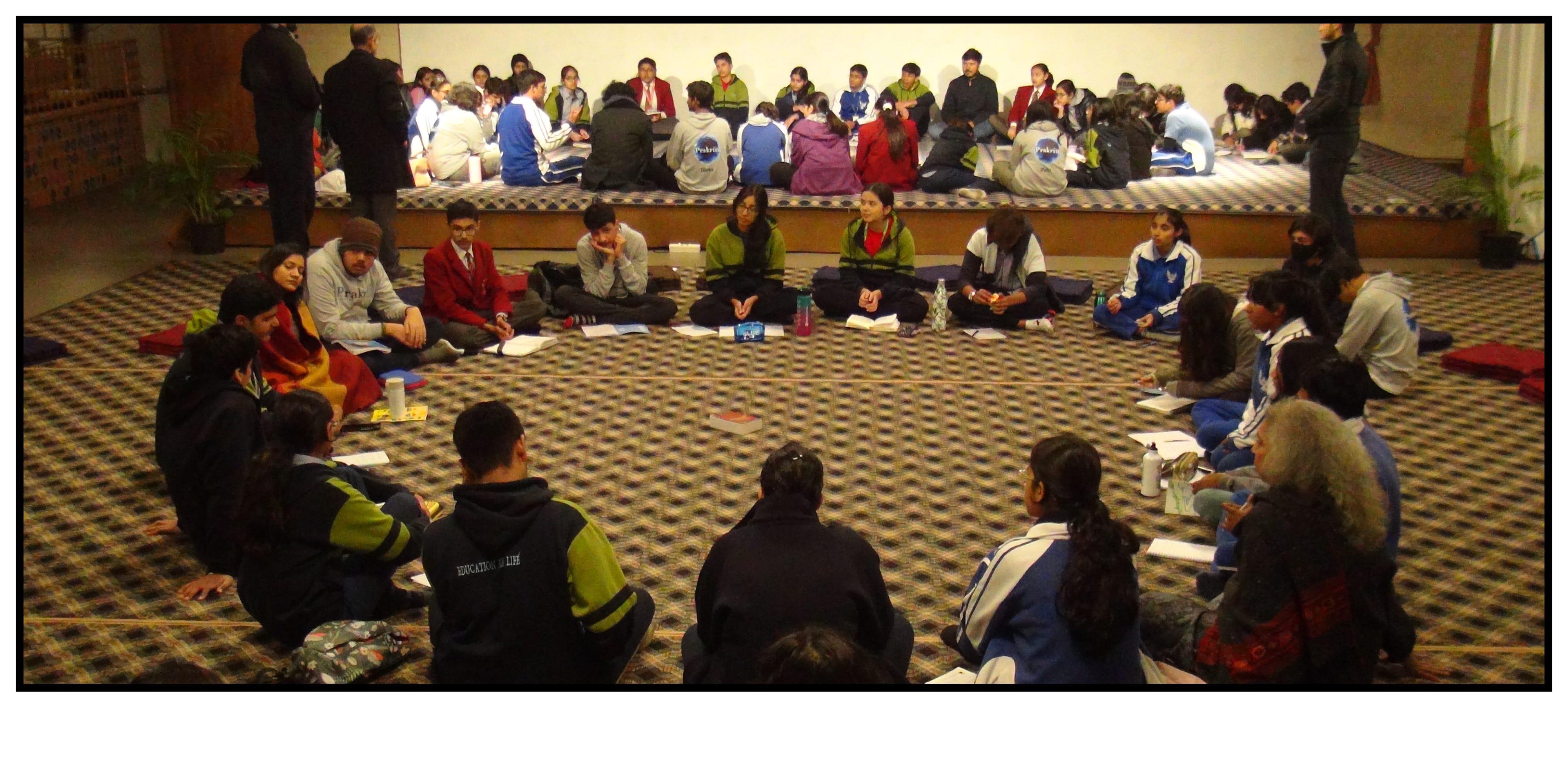
The first statement prompted deep discussion on identity and consciousness. Participants explored "I think, therefore I become," pondering if thoughts represent existence itself. Despite time limits, facilitators noted insightful contributions from teenagers. Discussions on “Because we die, life is meaningless” showed shifts from self-focus to considering others and leaving a meaningful legacy. Participants emphasized the connection between suffering and relationships in finding meaning. They redefined death as lost opportunities but with potential for new beginnings. Participants in Hocokah 2024, exemplified collaborative learning and true listening without competition.
A peek into the event:
“ It was music to our ears when participants shared that it was a very civilized discussion and that they could speak with such freedom without being judged or without feeling like wanting to prove themselves better than the other. We sincerely hope that this is a starting point for a deeply meaningful life for them all.”- Aman Verma, IGS Facilitator
As a token of appreciation all participants received the book, “Man’s Search for meaning” by Victor Frankl.
As Yuval Noah Harari said in his book" 21 lessons for the 21st century" one of the main skills is to develop the ability to know "Who am I"...by organizing such events Prakriti is setting a trend for 21st century teaching learning.
These are some very deep meaning dialogues! Philosophical and practical and philosophy is one subject that is being sidelined in our school system these days. The interaction of philosophy with reality builds so much perspective among young minds.
This has me thinking how each of the topics overlap one another. And this can be extended by forming bigger groups and discussing the interrelations between each. For instance- free will and religion, or comparison and free will etc. Culmination with a copy of a book is cherry on the cake. :)